Why do IMO safety signs need to meet specific luminance levels?
13.08.2026
IMO safety signs need to meet specific luminance levels because visibility in an emergency is the single most critical factor in whether people can find evacuation routes, firefighting equipment, and life-saving appliances quickly enough to survive. If a sign cannot be seen clearly in darkness, smoke, or power failure conditions, it fails its entire purpose. The sections below walk through the key questions shipbuilders and safety officers ask most often about luminance requirements.
What happens if IMO safety signs don’t meet luminance requirements?
If IMO safety signs fail to meet luminance requirements, they become unreliable guides during emergencies, which directly increases the risk of injury or death on board. Non-compliant signs may also result in failed port state control inspections, detentions, and significant liability exposure for shipowners and operators.
During a fire or flooding event, lighting systems can fail and smoke can reduce visibility dramatically. In these conditions, a sign that appears perfectly readable under normal lighting may be completely invisible if its photoluminescent material has degraded below the required brightness threshold. Crew and passengers rely on these signs to navigate unfamiliar spaces under extreme stress, so even a modest drop in luminance performance can have serious consequences.
From a regulatory standpoint, SOLAS requires that all safety signage on board meets the standards set out in the relevant IMO resolutions. Signs that fall below the required luminance levels expose the vessel to non-compliance findings during flag state surveys and port state control inspections. Depending on the severity, this can result in operational delays, mandatory rectification work, or vessel detention.
Which standards define luminance requirements for IMO safety signs?
Luminance requirements for IMO safety signs are primarily defined by IMO Resolution A.752(18) and ISO 15370:2021, with additional guidance from ISO 17398 for photoluminescent materials. These documents set minimum performance thresholds that all compliant marine safety signage must meet.
IMO Resolution A.752(18) establishes the foundational framework for the design, performance, and placement of safety signs on ships. It specifies that signs must be visible and recognisable under both normal and emergency lighting conditions. ISO 15370:2021 builds on this by setting detailed performance criteria for low location lighting systems and the signs integrated into them.
For photoluminescent signs specifically, ISO 17398 classifies luminescent materials by their afterglow performance, distinguishing between Class A and Class B materials based on how brightly and how long they continue to emit light after the excitation source is removed. Marine applications typically demand the highest performance class to ensure signs remain readable throughout a prolonged emergency.
SOLAS Chapter II-2 and Chapter III provide the overarching legal obligation, while the IMO resolution and ISO standards provide the technical detail on what compliance actually looks like in practice.
How is luminance measured and tested in IMO signs?
Luminance in IMO safety signs is measured in candelas per square metre (cd/m²) using calibrated photometric equipment, typically in a darkened test environment that simulates emergency conditions. Photoluminescent signs are charged under a specified light source and then measured at defined intervals after the light is removed.
The testing protocol matters as much as the measurement itself. For photoluminescent materials, the sign is fully charged under a standardised illuminance level, the light source is then switched off, and luminance readings are taken at set time intervals, commonly at 10 minutes, 60 minutes, and beyond. This captures both the initial brightness and the decay curve, since a sign might start brightly but fade below the required threshold too quickly to be useful.
For electrically illuminated signs, luminance is measured under operational conditions, verifying that the sign delivers consistent output across its entire face without hot spots or dim zones. Both sign types must demonstrate that they meet the minimum luminance threshold at the point in the test sequence that represents the most demanding real-world scenario.
What’s the difference between photoluminescent and electrically lit IMO signs?
Photoluminescent IMO signs absorb ambient light and re-emit it in darkness without any power source, while electrically lit signs use LEDs or other light sources to produce active illumination. The key distinction is that photoluminescent signs are passive and require no wiring, whereas electrically lit signs deliver higher and more consistent luminance but depend on a power supply.
Photoluminescent signs
Photoluminescent signs, sometimes called 3L-PL systems in next-generation configurations, are lightweight, straightforward to install, and require no electrical infrastructure. They work by absorbing light energy from ambient sources and releasing it gradually in darkness. Their luminance output is highest immediately after the light source is removed and decays over time, which is why the testing intervals described above are so important. Modern photoluminescent materials have improved significantly, with high-grade systems capable of maintaining readable luminance levels for many hours.
Electrically lit signs
Electrically lit systems, such as 3L-EP LED configurations, deliver consistent luminance regardless of prior light exposure. They are particularly valuable in spaces where ambient lighting levels are too low to reliably charge photoluminescent materials, or where the emergency scenario may last long enough to exhaust photoluminescent afterglow. We design our 3L-EP™ LED system to provide uninterrupted illumination across runs of up to 1,000 metres, making it well suited to complex vessel layouts. The trade-off is the need for cabling, power supply management, and a slightly more involved installation process.
Why do some IMO signs exceed the minimum luminance standard?
Some IMO safety signs exceed the minimum luminance standard because higher luminance improves visibility in challenging real-world conditions that the minimum threshold does not fully account for, such as heavy smoke, partial obstruction, or extended emergencies. Premium signs also provide a performance buffer that compensates for material degradation over the sign’s service life.
Standards set a floor, not a ceiling. A sign that just meets the minimum requirement on the day it is installed may fall below that threshold after several years of UV exposure, temperature cycling, or surface contamination. Signs manufactured with significantly higher initial luminance have a built-in margin that keeps them compliant for longer, reducing the frequency and cost of replacements.
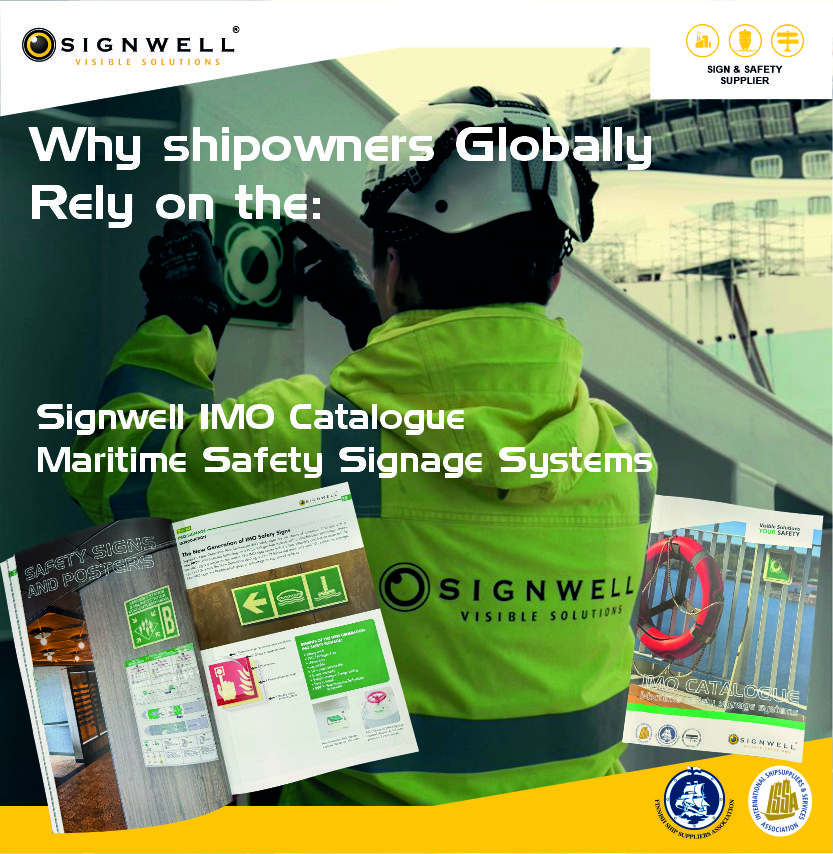
Our New Generation IMO signs are engineered to exceed standard requirements by a factor of four. This is not simply a marketing claim but a deliberate design decision rooted in the reality that marine environments are demanding, and a sign that performs well above the minimum on day one will still be performing reliably years into its service life. The materials are also PVC-free and halogen-free, contributing to both safety and environmental performance.
How can shipbuilders verify that installed IMO signs remain compliant over time?
Shipbuilders and operators can verify ongoing compliance through periodic luminance testing, structured inspection programmes, and documented maintenance records. Regular inspections against the original performance specification catch degradation before signs fall below the required threshold, keeping the vessel compliant between surveys.
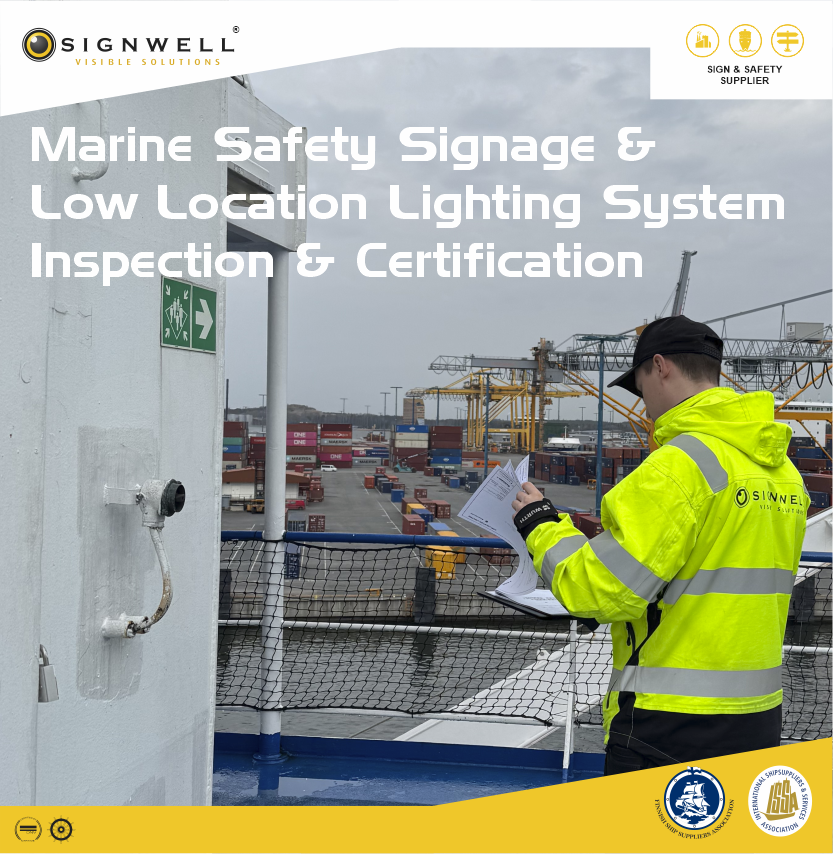
The most rigorous approach is a formal inspection programme carried out by qualified personnel. We offer 3L-SI™ inspections conducted by DNV-certified inspectors who assess the entire low location lighting and safety signage system against applicable standards. These inspections produce documented evidence of compliance, which is valuable both for internal quality assurance and for demonstrating conformity to flag state authorities and port state control officers.
Beyond formal inspections, there are practical steps shipbuilders can take during the installation phase to support long-term compliance:
- Select signs with luminance performance that significantly exceeds the minimum standard, providing a degradation buffer
- Ensure photoluminescent signs are installed in locations with adequate ambient light to charge them effectively
- Document the initial luminance performance of installed signs as a baseline for future comparison
- Establish a scheduled replacement cycle based on the manufacturer’s stated service life
- Use signs manufactured from UV-resistant materials to slow surface degradation in exposed locations
Compliance is not a one-time event at installation but an ongoing responsibility. Building a clear maintenance and inspection schedule into the vessel’s safety management system from the outset is the most reliable way to ensure that IMO safety signs continue to perform their life-saving function throughout the vessel’s operational life.
This content was generated with the help of AI and it may contain mistakes