What is the role of IMO safety signs during a maritime evacuation?
21.08.2026
IMO safety signs play a critical role during a maritime evacuation by guiding crew and passengers to emergency exits, muster stations, lifeboats, and firefighting equipment through universally recognised symbols. Because these signs communicate without language, they remain effective regardless of a person’s nationality or mother tongue. The sections below unpack how these signs function under pressure, where they must be placed, and what keeps them reliable throughout a vessel’s operational life.
What happens to visibility during a ship emergency?
During a ship emergency, visibility drops dramatically and rapidly. Smoke from fire fills corridors within minutes, electrical failures cut normal lighting, and disorientation sets in as people move through unfamiliar spaces under extreme stress. In these conditions, standard lighting and verbal instructions become unreliable, making fixed visual guidance systems the most dependable means of directing people to safety.
The physical environment on a vessel compounds the challenge. Passageways are narrow, stairwells are steep, and the layout of a ship is rarely intuitive to passengers or new crew members. When smoke descends, people instinctively crouch low, which shifts the effective sightline closer to the floor. Emergency signage systems designed for maritime use account for this by combining photoluminescent or electrically powered signs at low levels with clearly visible symbols at standard height, creating a layered guidance path that works even in near-zero visibility.
This is precisely why SOLAS regulations and IMO guidelines mandate dedicated emergency signage that functions independently of the main power supply and remains visible when conditions are at their worst.
What do IMO safety signs actually communicate on a vessel?
IMO safety signs communicate the location and direction of life-saving appliances, emergency exits, muster stations, fire-fighting equipment, and hazard areas using internationally standardised symbols. Each sign conveys a specific meaning without relying on text, making the message instantly readable regardless of the viewer’s language or literacy level.
The categories of information conveyed by marine safety signage include:
- Evacuation routes: Directional arrows and exit symbols guide people along designated escape paths to open deck areas.
- Muster and assembly stations: Signs indicate where passengers and crew must gather before boarding survival craft.
- Lifeboat and liferaft locations: Symbols identify the position and type of survival craft available on each deck.
- Fire safety equipment: Signs mark the location of extinguishers, hose reels, fire doors, and alarm call points.
- Prohibition and warning signs: Hazard symbols communicate restricted areas and dangerous conditions.
Together, these ship evacuation signs form a complete communication system that operates independently of crew instruction, which is essential when crew members are managing multiple emergencies simultaneously.
How does IMO symbol standardisation improve evacuation outcomes?
IMO symbol standardisation improves evacuation outcomes by eliminating language barriers and ensuring that every person on board, regardless of nationality, can interpret emergency signage correctly and immediately. When symbols are consistent across all vessels globally, seafarers who transfer between ships and passengers who travel internationally carry transferable knowledge of what each sign means.
The IMO symbol system is governed by international resolutions and standards, including IMO Resolution A.752(18) and ISO 15370:2021, which define the exact appearance, colour coding, and meaning of each symbol. This consistency means there is no ambiguity between one vessel and another. A green running figure above an arrow means the same thing on a cruise ship in the Mediterranean as it does on a cargo vessel in the South China Sea.
Standardisation also supports crew training. When symbols are universal, safety drills and familiarisation procedures become more efficient because crew members do not need to learn a vessel-specific sign system from scratch. This reduces the margin for error during an actual emergency evacuation in the maritime environment, where seconds matter and cognitive load is already high.
Where must IMO safety signs be placed on a ship?
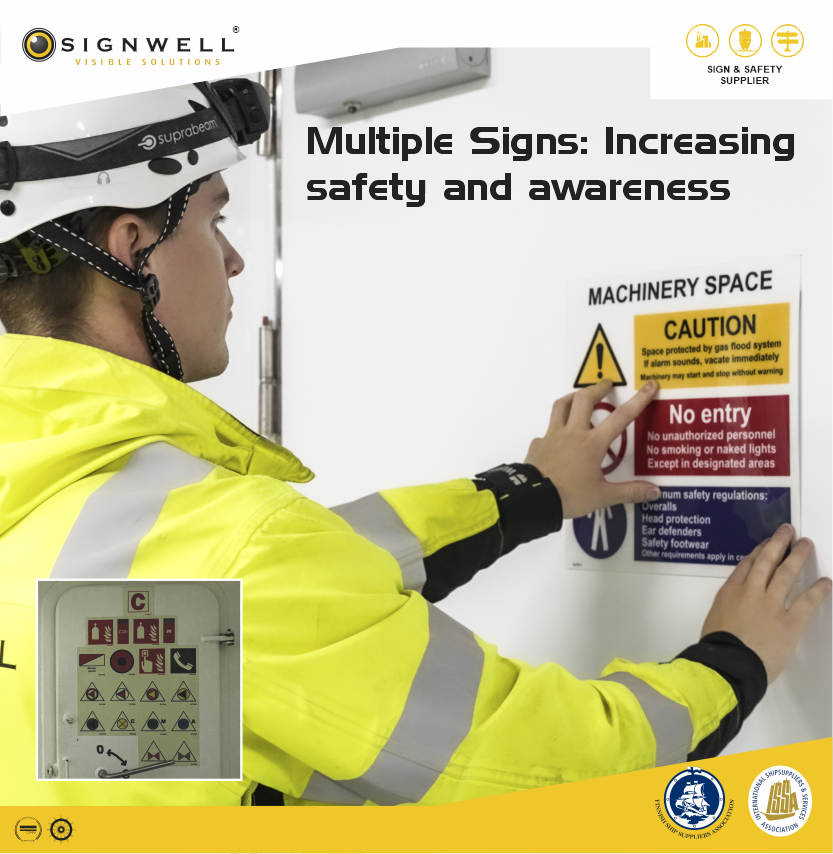
IMO safety signs must be placed at every decision point along an evacuation route, including corridor junctions, stairwell entrances and exits, muster station approaches, and at the location of each piece of life-saving or fire-fighting equipment. Placement is governed by SOLAS regulations and flag state requirements, which specify that signage must be visible from a reasonable distance and must not be obstructed by fittings or furniture.
Key placement requirements include:
- Exit and directional signs at every change of direction along an escape route
- Signs at the entrance to each stairwell indicating the direction of travel to open deck
- Muster station signs visible from the approach routes leading to each station
- Equipment location signs positioned directly above or adjacent to the equipment they identify
- Low-level guidance signs or photoluminescent pathway markings in accommodation spaces and corridors where smoke accumulation is likely
Passenger vessels face particularly detailed placement requirements because passengers are unfamiliar with the ship’s layout. On these vessels, emergency evacuation maritime signage must be comprehensive enough that a person with no prior knowledge of the vessel can navigate from their cabin to their muster station without assistance.
What materials make IMO signs reliable in extreme conditions?
IMO safety signs are reliable in extreme conditions when manufactured from photoluminescent materials, rigid marine-grade substrates, or high-performance polymers that resist heat, moisture, UV exposure, and chemical contact. The material choice directly determines whether a sign remains legible and structurally intact throughout the life of the vessel.
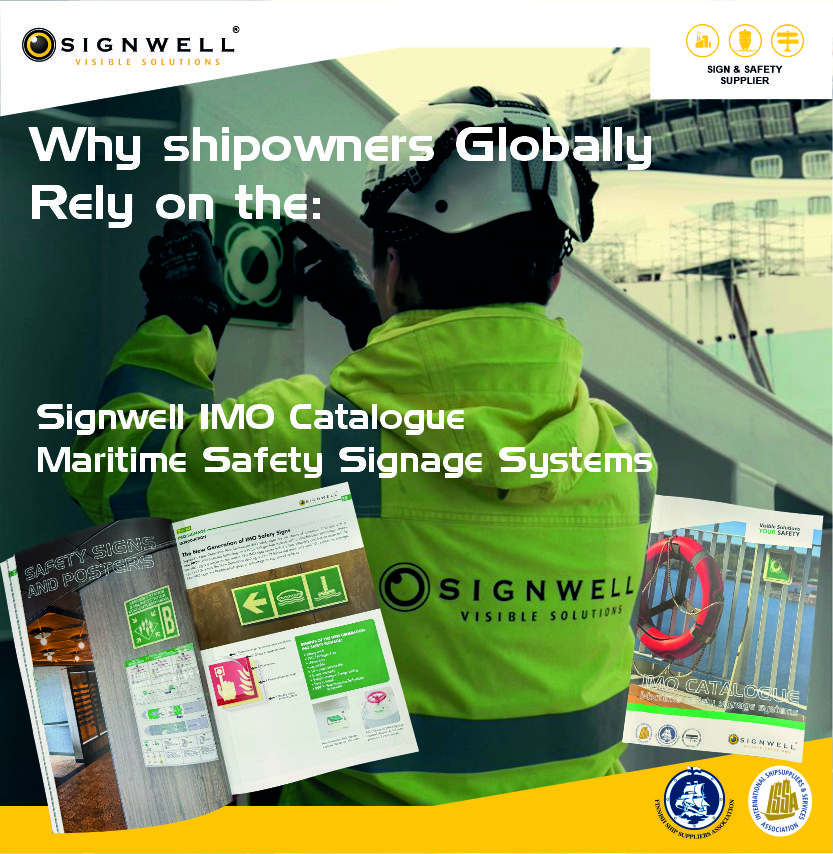
Our New Generation IMO signs are manufactured from PVC-free and halogen-free materials, which means they do not release toxic gases when exposed to fire. This matters significantly in an emergency, as burning signage materials that release harmful fumes would compound the hazard they are meant to mitigate. These signs exceed standard requirements by a factor of four, providing a substantial safety margin above the minimum compliance threshold.
For photoluminescent signs, the quality of the luminescent pigment determines how long the sign remains visible after the light source is removed. High-grade photoluminescent marine safety signage charges quickly under ambient lighting and emits guidance-level brightness for several hours in darkness. For electrically powered systems, components must be rated for the vessel’s operating temperature range and protected against the humidity and salt air inherent in the maritime environment.
How often should IMO safety signs be inspected and maintained?
IMO safety signs should be inspected at every safety equipment survey, which typically occurs annually as part of flag state and classification society requirements, as well as during routine safety inspections conducted by the ship’s safety officer. Any sign that is damaged, faded, obscured, or missing must be replaced before the vessel sails.
Practical maintenance involves three levels of activity:
- Daily and weekly checks: The officer of the watch or designated crew member verifies that signs along key escape routes are unobstructed and undamaged during routine rounds.
- Annual surveys: A thorough inspection of all shipboard signage against the vessel’s approved safety plan, checking for compliance with current IMO symbols and SOLAS safety signs requirements. Classification societies and flag state inspectors will examine sign condition and placement during statutory surveys.
- Post-incident and post-refit reviews: After any fire, flooding, or major maintenance work, all signs in affected areas must be checked and replaced as necessary, since heat, water damage, and construction work can compromise sign integrity without being immediately obvious.
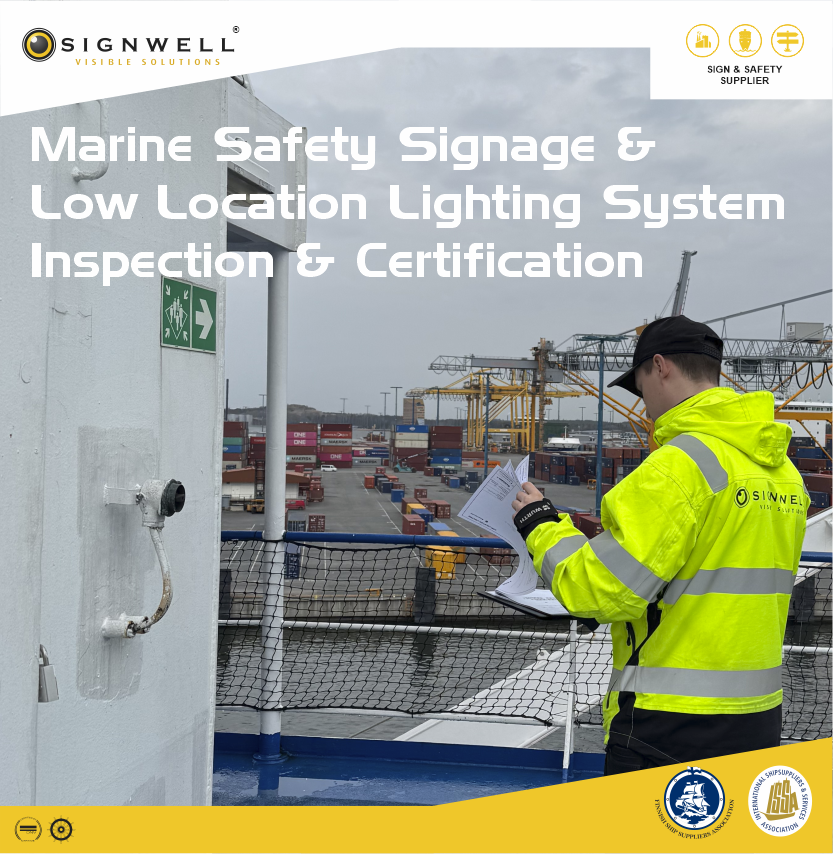
Our DNV-certified inspectors carry out 3L-SI™ system inspections that verify both the condition of individual signs and the completeness of the overall evacuation signage system, ensuring nothing has been missed during a refit or modification programme. Keeping inspection records current is also important for demonstrating regulatory compliance during port state control examinations, where deficient or missing emergency evacuation maritime signage can result in detentions and operational delays.
This content was generated with the help of AI and it may contain mistakes