What are the 4 types of safety signs?
5.11.2025
Safety signs fall into four main types: warning signs (yellow triangles alerting to hazards), mandatory signs (blue circles requiring specific actions), prohibition signs (red circles with diagonal bars forbidding actions), and emergency information signs (green for exits, red for fire equipment). Each type uses distinct colours, shapes, and symbols to communicate critical safety information instantly. Understanding these categories helps create comprehensive safety systems that protect workers and ensure regulatory compliance across industrial and maritime environments.
What are the 4 main types of safety signs and why do they matter?
The four primary safety sign categories serve distinct communication purposes in workplace safety. Warning signs alert people to potential hazards without prohibiting access. Mandatory signs require specific safety actions like wearing protective equipment. Prohibition signs forbid dangerous behaviours or access to restricted areas. Emergency and information signs guide people to safety equipment and evacuation routes during emergencies.
These categories use standardised visual characteristics that transcend language barriers. Warning signs feature yellow or amber triangular designs with black borders and symbols. Mandatory signs appear as blue circles with white pictograms showing required actions. Prohibition signs use red circles with diagonal bars crossing out forbidden activities. Emergency signs employ green backgrounds for safe conditions and exits, whilst fire equipment signs use red backgrounds.
Standardisation matters because it creates universal safety communication. International standards like ISO 7010 ensure that safety signs convey identical meanings across different countries and industries. This consistency becomes particularly important in maritime environments, where crew members from various nationalities must understand safety instructions instantly. The recognisability of standardised safety signs can mean the difference between confusion and decisive action during emergencies.
Regulatory compliance depends on implementing all four sign types appropriately. Industrial facilities and vessels must display warning signs near hazards, mandatory signs where protective equipment is required, prohibition signs in restricted areas, and emergency signs along evacuation routes. This comprehensive approach creates layered safety communication that addresses prevention, protection, and emergency response.
How do you identify and use warning signs in the workplace?
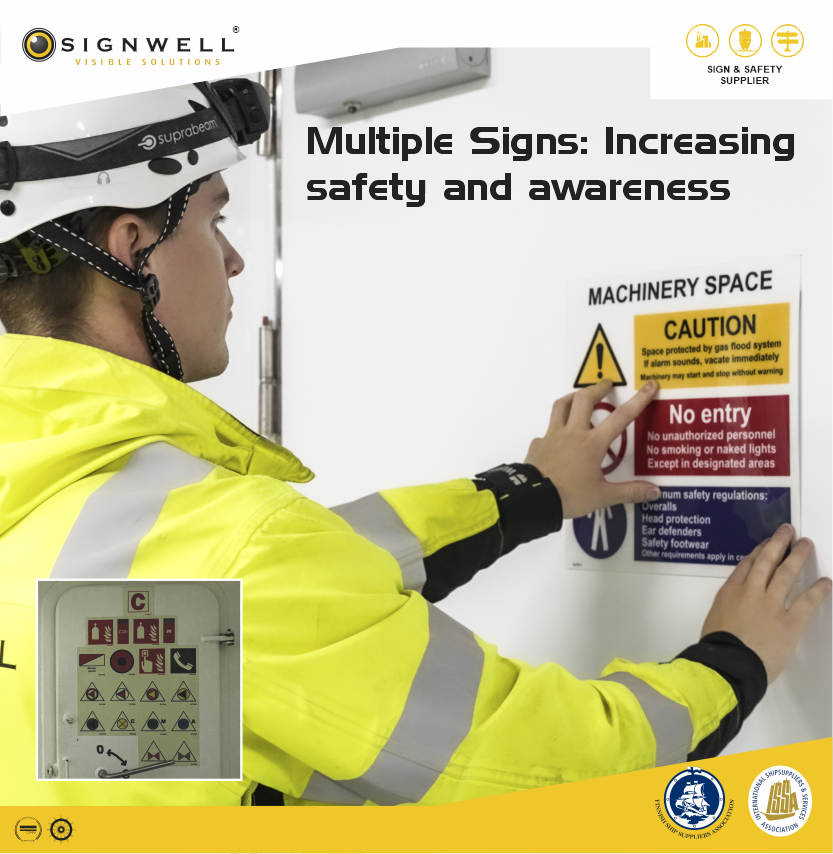
Warning signs feature a distinctive yellow or amber triangular shape with black borders and black symbols. This high-contrast design catches attention without creating the urgency of prohibition signs. Common warning symbols include lightning bolts for electrical danger, skull and crossbones for toxic substances, exclamation marks for general caution, and pictograms showing specific hazards like slippery surfaces, overhead loads, or chemical exposure.
The placement of warning signs follows risk assessment principles. Position them at eye level where people can see them before encountering the hazard. In industrial facilities, warning signs should appear at entrances to hazardous areas, on equipment that poses risks, and along pathways where dangers exist. Maritime and offshore environments require warning signs near machinery spaces, chemical storage areas, and locations with environmental hazards like high temperatures or pressure systems.
Warning signs differ from prohibition signs in their function. They alert people to exercise caution and take appropriate precautions rather than forbidding entry or activity. Someone might proceed past a “Caution: Slippery Surface” warning sign after noting the hazard and adjusting their behaviour, whereas a prohibition sign would prevent them from entering entirely. This distinction makes warning signs valuable for areas where work must continue despite inherent risks.
Effective warning sign strategies consider both onshore and offshore contexts. Offshore platforms and vessels face additional challenges including weather exposure, salt spray, and limited evacuation options. Warning signs in these environments require materials that withstand harsh conditions whilst maintaining visibility. The signs must remain legible through years of exposure to ensure they continue protecting workers who may encounter hazards during routine operations or emergency situations.
What’s the difference between mandatory signs and prohibition signs?
Mandatory signs command specific actions, whilst prohibition signs forbid certain behaviours. Mandatory signs appear as blue circles with white pictograms showing required safety measures like wearing hard hats, safety goggles, hearing protection, or safety harnesses. Prohibition signs use red circles with diagonal bars crossing out forbidden activities like smoking, using mobile phones, or entering without authorisation.
The psychological distinction between these sign types reflects how humans process commands. Mandatory signs tell people what they must do to stay safe, creating positive action requirements. Prohibition signs tell people what they must not do, establishing boundaries and restrictions. This separation helps workers understand whether a situation requires them to take protective action or simply avoid certain behaviours.
Placement strategies differ between these sign types based on their functions. Position mandatory signs at entrances to areas where specific personal protective equipment becomes necessary. Workers should encounter these signs before entering spaces where protection is required, giving them opportunity to don appropriate gear. Prohibition signs work best at boundaries of restricted areas, near equipment where certain actions create hazards, and in locations where specific behaviours pose safety risks.
Both sign types contribute to comprehensive safety culture by establishing clear expectations. Mandatory signs demonstrate that the organisation provides protective measures and expects workers to use them. Prohibition signs show that certain risks are unacceptable and must be avoided entirely. Together, they create a framework where workers understand both their safety responsibilities and the boundaries they must respect. Compliance with both mandatory and prohibition signage requirements helps organisations meet regulatory standards whilst protecting their workforce from preventable injuries.
Why are emergency and evacuation signs critical for life safety?
Emergency and evacuation signs guide people to safety during crises when confusion and stress impair decision-making. These signs use green backgrounds to indicate safe conditions, exits, and evacuation routes, whilst red backgrounds mark fire equipment locations. The colour coding creates instant recognition that helps people navigate toward safety and locate emergency equipment even when visibility is compromised.
Fire safety signs include markers for extinguishers, fire alarms, hose reels, and assembly points. First aid signs indicate the locations of medical supplies, emergency showers, and eye wash stations. Exit signs mark primary and alternative escape routes, whilst assembly point signs designate safe gathering locations outside buildings or vessels. This comprehensive signage system ensures people can find what they need regardless of where an emergency occurs.
Visibility during power loss situations presents a critical challenge for emergency signage. Standard signs become invisible when lighting fails, potentially trapping people in darkness during fires or other emergencies. Photoluminescent signs absorb ambient light and glow in darkness, providing guidance without electrical power. Advanced Low Location Lighting systems use photoluminescent materials or LED technology to create continuous illuminated pathways along escape routes, marking exits, obstacles, and direction changes at floor level where visibility remains clearest through smoke.
Maritime environments face unique emergency signage requirements under SOLAS (Safety of Life at Sea) and IMO regulations. Vessels and offshore platforms must implement standardised IMO signs manufactured according to ISO standards. We produce New Generation IMO signs that are PVC-free and halogen-free, offering environmental benefits whilst exceeding standard luminescence requirements. These signs withstand harsh marine conditions including salt spray, UV exposure, and temperature extremes whilst maintaining visibility for over 10 years. The integration of emergency signage with evacuation planning ensures that crew members and passengers can navigate to muster stations and lifeboats even during catastrophic failures of ship systems.
How do you choose the right safety signs for your facility?
Selecting appropriate safety signs begins with comprehensive hazard assessment. Walk through your facility identifying specific dangers that require warning signs, areas where protective equipment becomes mandatory, activities that must be prohibited, and emergency equipment locations that need marking. This assessment should consider both routine operations and potential emergency scenarios to ensure complete coverage.
Industry standards and regulatory requirements determine which signs you must display. ISO 7010 provides internationally recognised safety symbols for general industry. Maritime facilities must comply with IMO Resolution A.1116(30), which mandates that all safety signage aboard vessels follows ISO 7010 and ISO 24409-2 standards. OSHA regulations in the United States establish additional requirements for workplace safety signage. Understanding which standards apply to your operations ensures legal compliance whilst implementing recognised best practices.
Environmental conditions significantly impact material selection for safety signs. Consider temperature ranges, chemical exposure, UV radiation, moisture levels, and physical abuse that signs will endure. Standard signs may suffice for climate-controlled indoor environments, whilst offshore platforms and industrial facilities require premium materials. Signs rated for extreme temperatures from -40°C to +150°C ensure visibility in both arctic conditions and near high-temperature processes. UV-resistant materials prevent fading and discolouration that would compromise sign effectiveness over time.
Placement strategies affect how well safety signs fulfil their protective function. Position signs at eye level where possible, ensuring adequate lighting for visibility during normal operations. Emergency signs require photoluminescent or illuminated options that remain visible during power failures. Consider viewing angles and potential obstructions that might hide signs from approaching workers. In multilingual workplaces, supplement or replace text-based signs with symbol-based alternatives that communicate across language barriers.
Maintenance requirements ensure long-term effectiveness of your safety signage system. Establish inspection schedules to identify damaged, faded, or missing signs requiring replacement. High-quality signs with protective coatings resist dirt accumulation and allow easy cleaning without degrading the sign surface. We manufacture signs with glossy, high-quality finishes that are easy to wipe clean whilst maintaining flame retardant properties. Comprehensive safety sign systems combine all four sign types strategically throughout facilities, creating clear, consistent safety communication that protects workers whilst ensuring compliance with international safety regulations.
This content was generated with the help of AI and it may contain mistakes