How does salt air and humidity affect IMO safety sign lifespan?
17.09.2026
Salt air and humidity significantly shorten IMO safety sign lifespans, with unprotected signs in harsh marine environments degrading visibly within two to five years. The combination of salt crystals, moisture penetration, and UV exposure attacks adhesives, substrates, and photoluminescent layers simultaneously. Material choice is the single biggest factor determining how long a sign survives at sea. The sections below answer the most common questions about marine corrosion, material selection, inspection schedules, and offshore versus coastal performance.
How quickly does marine corrosion degrade safety sign materials?
Marine corrosion can begin degrading low-quality IMO safety sign materials within months of installation. Salt particles carried in sea spray deposit on sign surfaces, draw in moisture, and create an electrochemical environment that attacks metal fixings, laminates, and adhesive layers. In open-deck or engine-room conditions, visible deterioration such as delamination, fading, and edge lifting can appear in under two years on substandard signs.
The rate of degradation depends on several interacting factors. Proximity to the waterline accelerates salt loading. Fluctuating temperatures cause materials to expand and contract, opening microscopic cracks where salt and moisture can penetrate further. Diesel exhaust, cleaning chemicals, and mechanical vibration add additional stress. Signs made from PVC-based materials are particularly vulnerable because PVC becomes brittle over time in UV-rich, salt-laden conditions, eventually cracking and losing legibility.
Premium-grade signs built from engineered polymers and halogen-free substrates resist this process far more effectively. Their closed-cell structures limit moisture absorption, and their surface treatments resist salt crystal adhesion. The difference in real-world lifespan between a budget sign and a properly specified marine-grade sign can be measured in decades rather than years.
Which IMO sign materials resist salt and humidity best?
Rigid photoluminescent signs made from halogen-free, UV-stabilised polymers offer the strongest resistance to salt air and humidity in marine environments. These materials combine low moisture absorption with dimensional stability across wide temperature ranges, preventing the warping, cracking, and delamination that end the functional life of lesser signs. Aluminium-backed signs with corrosion-resistant coatings also perform well when correctly sealed at the edges.
The key properties to look for in a marine-grade IMO safety sign material are:
- Halogen-free and PVC-free substrate for long-term dimensional and chemical stability
- UV resistance to prevent fading and surface degradation from sunlight exposure on open decks
- Closed-cell or non-porous surface to block salt crystal and moisture ingress
- Temperature tolerance across the full operational range of the vessel, ideally from -40°C to +150°C
- Corrosion-resistant fixings in stainless steel or marine-grade aluminium to prevent rust staining and structural failure
Our New Generation IMO signs are manufactured from PVC-free and halogen-free materials that exceed standard requirements by a significant margin, giving them a service life that makes them genuinely cost-effective over the full operational period of a vessel rather than just at the point of purchase.
Does humidity affect photoluminescent glow performance on IMO signs?
High humidity can reduce photoluminescent glow output on IMO signs if moisture penetrates the luminescent layer or condenses on the sign surface. A film of moisture scatters the emitted light and reduces apparent brightness, which matters most in the first critical minutes of an emergency evacuation when maximum visibility is essential. Encapsulated photoluminescent layers protected by a hard, moisture-resistant topcoat largely eliminate this problem.
The underlying photoluminescent pigment itself is not chemically destroyed by humidity in normal marine conditions, but long-term moisture exposure can cause delamination between the luminescent layer and its substrate. Once delamination begins, the sign’s ability to charge under ambient light is compromised because air gaps disrupt the optical path. Signs that show bubbling, milky discolouration, or surface cloudiness have typically reached this point and need replacement.
For vessels operating on tropical or high-humidity routes, specifying signs with sealed, multi-layer construction is the most reliable way to maintain glow performance across the full service interval between inspections.
Where on a vessel are IMO signs most exposed to salt and humidity damage?
The locations with the highest salt and humidity exposure on a vessel are open weather decks, lifeboat stations, bow and stern areas, engine rooms, and any corridor or stairwell with direct access to the exterior. These zones combine salt spray, condensation cycles, heat, and mechanical vibration in ways that accelerate every mode of sign degradation simultaneously.
Within a vessel, the risk profile varies by zone:
- Open weather decks: Maximum UV, salt spray, and temperature cycling. Signs here face the harshest combined exposure on the ship.
- Engine rooms and machinery spaces: High heat, oil vapour, and humidity from cooling water systems. Adhesives and laminates are particularly vulnerable.
- Lifeboat and muster stations: Exterior exposure combined with high-stakes safety function. Sign legibility here is critical under SOLAS requirements.
- Stairwells and escape routes connecting interior to exterior: Condensation forms where warm interior air meets cold bulkheads, creating persistent moisture on sign surfaces.
- Below-deck accommodation passageways: Lower direct salt exposure, but humidity from occupancy and ventilation systems still affects adhesives over time.
Knowing which zones carry the highest risk allows project managers to specify different performance grades for different locations rather than applying a single standard across the whole vessel, which can lead to either unnecessary cost or underspecification in the most demanding areas.
How often should IMO safety signs be inspected in marine environments?
IMO safety signs in marine environments should be visually inspected at every scheduled safety drill and formally surveyed at least annually, with a comprehensive condition assessment aligned to each class society survey cycle. SOLAS requires that life-saving appliances and their associated signage are maintained in working order, which in practice means any sign showing fading, delamination, cracking, or illegibility must be replaced before the next survey.
A practical inspection schedule for marine safety signage typically follows three tiers:
- Monthly visual checks by the ship’s safety officer, focusing on open-deck and muster-station signs for obvious physical damage or fading
- Annual formal inspection covering all sign locations, checking photoluminescent glow performance, fixing integrity, and surface condition
- Full compliance survey at each class renewal or flag state inspection, verifying that all signs meet current IMO and SOLAS standards and that replacements use approved materials
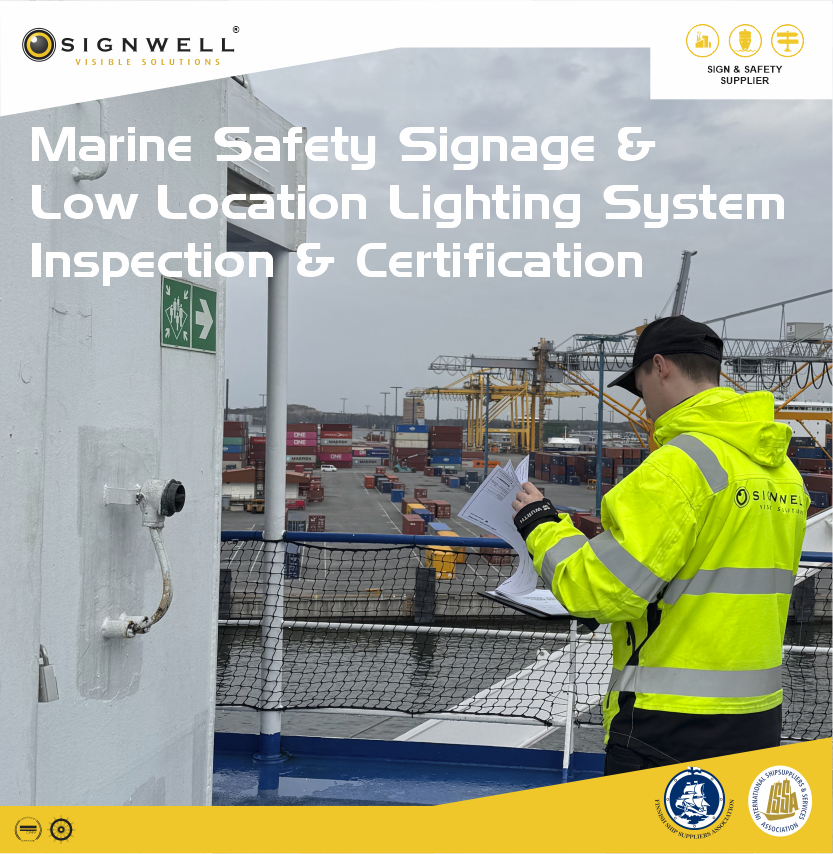
In particularly aggressive environments such as offshore platforms or vessels on Arctic or tropical routes, shortening the formal inspection interval to every six months is a sensible precaution. Our DNV-certified inspectors carry out 3L-SI inspections that assess the full safety signage and low-location lighting system in a single coordinated survey, which simplifies compliance documentation considerably for busy fleet operators.
What’s the difference between IMO signs rated for offshore versus coastal use?
IMO signs rated for offshore use are built to withstand continuous, unprotected exposure to salt spray, extreme temperatures, and UV radiation over multi-year service intervals without maintenance access. Coastal-use signs are designed for less severe salt loading and more frequent maintenance opportunities. The distinction comes down to material specification, encapsulation quality, and the temperature and UV resistance ranges the sign is engineered to sustain.
Offshore-rated signs typically meet a higher performance threshold in several measurable ways. Their photoluminescent layers are fully encapsulated rather than surface-applied, preventing moisture ingress even when the sign face is regularly wetted. Their substrates maintain dimensional stability across wider temperature swings, which matters on platforms where daytime surface temperatures can reach extreme highs and nighttime temperatures drop sharply. Fixings are specified in marine-grade stainless steel rather than coated carbon steel.
Coastal or harbour-use signs operate in a less aggressive environment where salt loading is lower, temperatures are more moderate, and the sign can be accessed for cleaning and inspection more frequently. A sign correctly specified for coastal use is not a substandard product; it is simply matched to its actual operating conditions. Overspecifying for every location adds unnecessary cost, while underspecifying in offshore conditions creates a genuine safety risk as signs degrade faster than the inspection cycle can catch.
For project managers working across both vessel types and fixed offshore installations, the most reliable approach is to define the exposure zone for each sign location before specifying materials, rather than applying a single product grade across the whole project. This is exactly the kind of technical guidance we provide during the planning phase of a new build or refit.
Looking for marine-grade signage built to withstand the demands of salt air, humidity, and UV exposure? Explore Signwell’s IMO signs to find compliant safety signage suited to the full range of vessel and offshore installation environments.
This content was generated with the help of AI and it may contain mistakes