Can IMO safety signs be self-installed or must a certified technician do it?
19.08.2026
Most IMO safety signs can be self-installed by trained crew members or ship staff without requiring a certified technician. However, Low Location Lighting (LLL) systems and photoluminescent escape route systems must be installed and inspected by a certified professional to meet SOLAS compliance requirements. The specific rules depend on the sign type, the vessel’s flag state, and the applicable international standards.
For new build projects and major refits, the distinction between what crew can handle and what requires certified expertise becomes especially important. The sections below break down each aspect of IMO safety sign installation compliance, from basic requirements to full project planning.
What are the official installation requirements for IMO safety signs?
IMO safety sign installation is governed primarily by SOLAS (Safety of Life at Sea) regulations and IMO Resolution A.952(23), which sets the graphical symbols and placement standards for shipboard safety signs. Signs must be positioned at the correct height, clearly visible, and compliant with the photometric and material specifications outlined in ISO 15370:2021 and related standards. Placement locations are not discretionary.
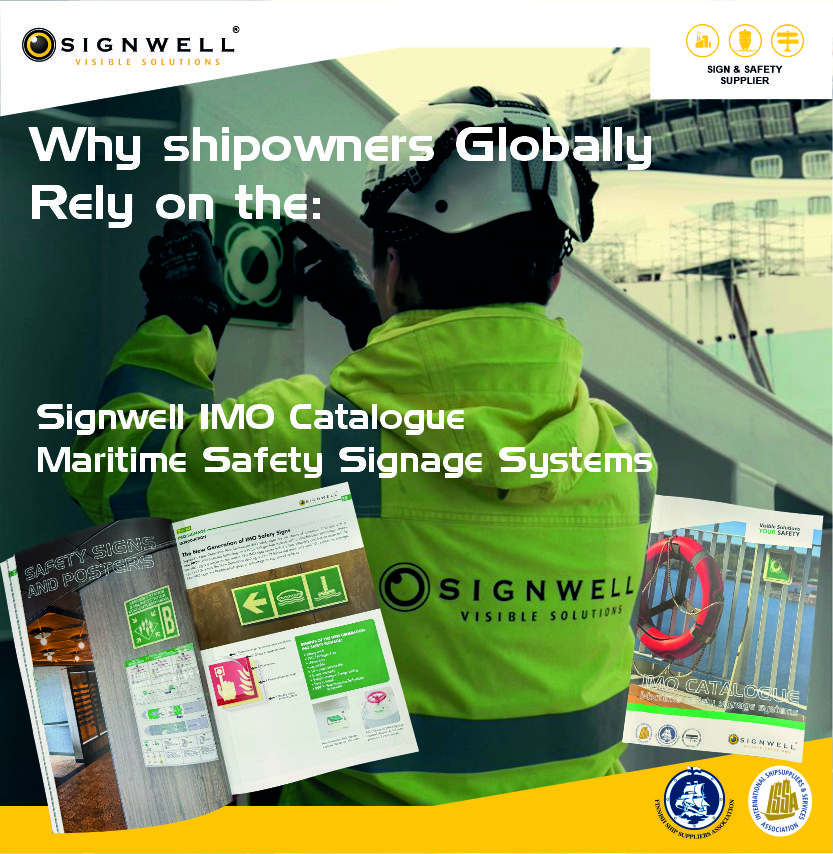
Beyond position and visibility, the materials used must meet durability requirements. Signs installed in marine environments face extreme conditions, including UV exposure, salt air, temperature swings, and vibration. This is why compliant signs must be manufactured from materials that can withstand these conditions over their service life. Our New Generation IMO signs, for example, are made from PVC-free and halogen-free materials and are engineered to exceed standard requirements by a significant margin.
Flag state administrations may impose additional requirements on top of the IMO baseline. Vessels operating under certain flags may need to follow supplementary national guidance, which is why shipbuilders and operators should always verify requirements with their classification society early in the project.
Can crew members or ship staff install IMO safety signs themselves?
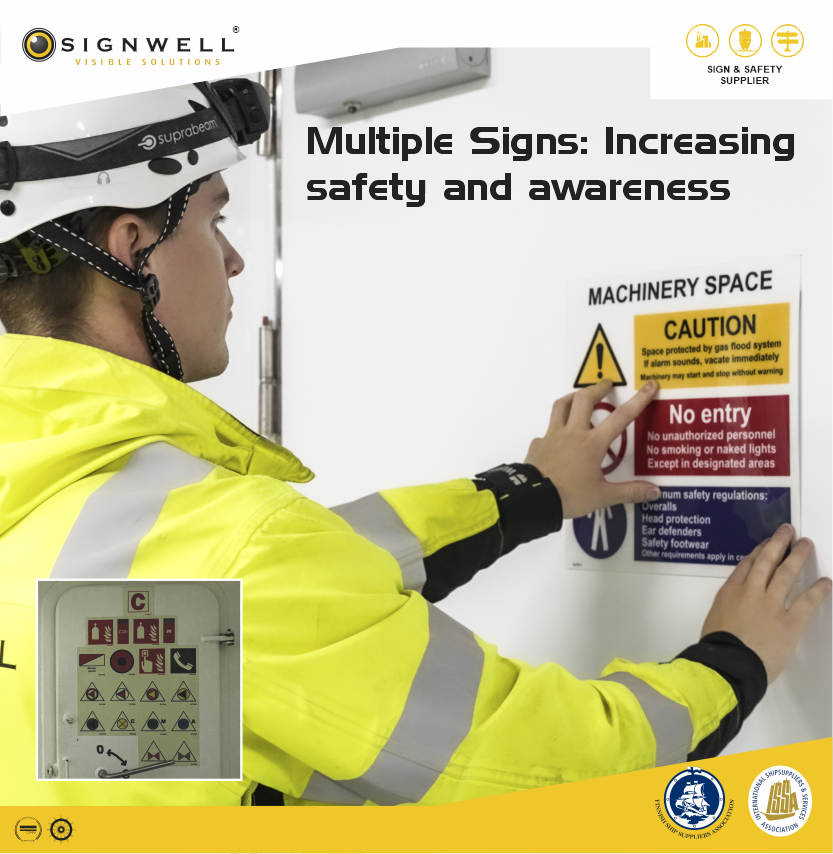
Yes, standard IMO pictogram signs such as fire equipment signs, lifeboat and rescue signs, and general safety signs can typically be installed by crew members or ship staff without a certified technician, provided the installation follows the correct placement specifications and the signs themselves are compliant with IMO and SOLAS standards. The key requirement is that the right signs go in the right places.
Crew-led installation works well when a clear installation plan has been prepared in advance, sign positions are marked or documented, and the signs being installed carry the correct certifications. Problems arise not from who installs the sign, but from incorrect placement, use of non-compliant products, or missing signs in required locations.
For straightforward sign replacement or additions during routine maintenance, trained crew members are generally well-positioned to carry out the work. The critical step is ensuring that the signs used are genuinely compliant and that the placement matches the vessel’s approved safety plan.
When is a certified technician legally required for sign installation?
A certified technician is legally required when installing Low Location Lighting (LLL) systems, including photoluminescent and electrically powered escape route guidance systems. Under SOLAS and IMO MSC circulars, these systems must be installed according to an approved design plan and subsequently inspected and certified by a qualified professional before the vessel can receive or maintain its safety certification.
The rationale is straightforward. LLL systems are life-safety critical. In an emergency, they guide passengers and crew to exits in zero-visibility smoke conditions. An incorrectly installed system can fail at exactly the moment it is needed most. Classification societies such as DNV, Lloyd’s Register, and Bureau Veritas require that these systems be verified by certified inspectors as part of the vessel’s safety management documentation.
Additionally, any installation that forms part of a new build’s approved safety plan or that requires a classification society survey sign-off will require certified involvement. If you are unsure whether your specific installation falls into this category, your classification society is the authoritative source.
What does a certified IMO sign inspection actually involve?
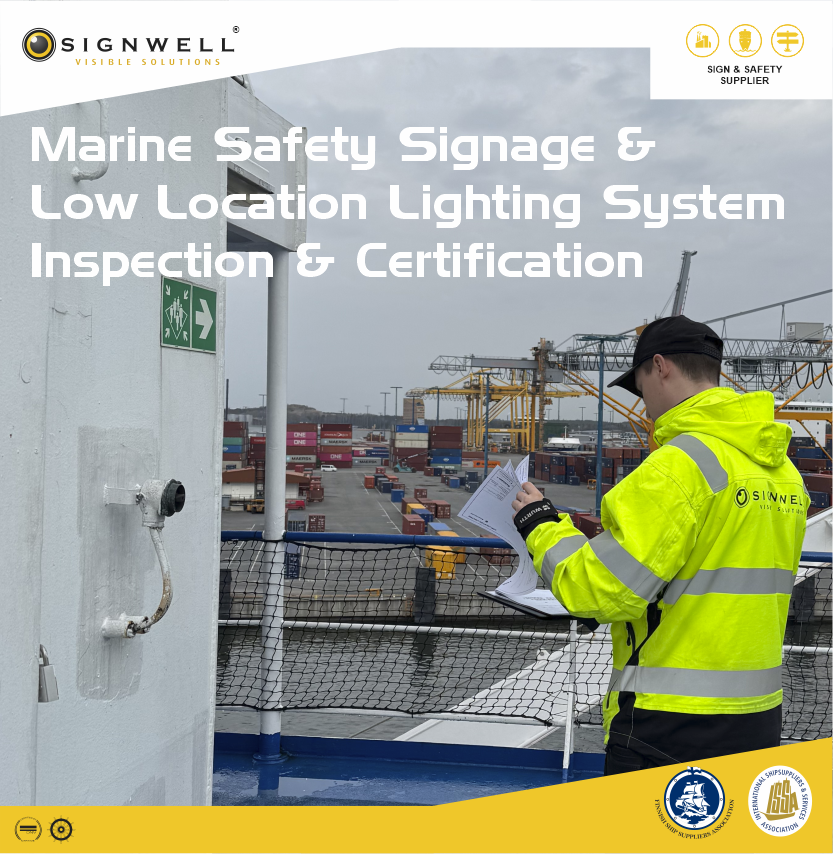
A certified IMO sign inspection involves a systematic review of all safety signage and LLL systems against the vessel’s approved safety plan, SOLAS requirements, and applicable ISO standards. The inspector checks sign placement, visibility, material compliance, condition, and whether the full set of required signs is present. For LLL systems, performance testing and documentation of the installed system are also part of the process.
Our DNV-certified inspectors carry out 3L-SI inspections that cover the complete lifecycle of a Low Location Lighting installation. This includes verifying that the system was installed according to the approved design, that photoluminescent materials meet brightness and duration requirements, and that electrical components in LED-based systems are functioning correctly.
The inspection produces documentation that becomes part of the vessel’s safety certification file. This paperwork matters during port state control inspections, insurance reviews, and flag state audits. A well-documented inspection record is a practical asset, not just a regulatory formality.
What risks come with non-compliant IMO sign installation?
Non-compliant IMO safety sign installation creates serious legal, operational, and safety risks. On the regulatory side, a vessel with non-compliant signage can be detained by port state control, fail classification society surveys, and face significant delays and costs to remediate. In the worst case, insurance coverage may be affected if an incident occurs and non-compliance is identified as a contributing factor.
From a safety perspective, the consequences can be far more severe. IMO safety signs exist to guide people to safety under emergency conditions when stress, smoke, and noise impair decision-making. Missing, incorrectly placed, or substandard signs can directly cost lives during a fire or flooding event.
There is also a project cost dimension that shipbuilders and operators often underestimate. Discovering non-compliance during a survey or port state inspection means unplanned remediation work, potential dry-docking, and schedule disruption. Investing in correct installation from the start is consistently less expensive than correcting it after the fact.
How should shipbuilders plan IMO sign installation for a new build project?
Shipbuilders should integrate IMO sign installation planning into the early design phase, not treat it as a finishing task. The process starts with producing a comprehensive safety sign and LLL layout plan that aligns with the vessel’s approved evacuation routes, the applicable SOLAS chapter, and the classification society’s requirements. This plan becomes the reference document for procurement, installation, and inspection.
A practical planning sequence looks like this:
- Engage your classification society early to confirm which standards and sign types apply to the vessel’s flag, route, and passenger or crew capacity.
- Develop a complete sign schedule covering every required location, sign type, and material specification before procurement begins.
- Source compliant products from a manufacturer who can provide full documentation, including material certifications and standard conformance declarations.
- Coordinate installation timing so signs are fitted after surface finishes are complete but with enough time for inspection before delivery.
- Schedule certified inspection of LLL systems and any other survey-required elements with sufficient lead time to address any findings before the delivery date.
We offer turnkey solutions that cover design, manufacturing, installation, and certified inspection as a single coordinated service. For shipbuilders managing complex new build schedules, having one partner responsible for the full chain from sign layout planning through to DNV-certified inspection significantly reduces coordination risk and keeps the project on schedule.
The most common planning mistake is treating IMO sign installation as a standalone procurement task rather than an integrated part of the vessel’s safety system design. Starting early, using certified products, and building inspection into the project timeline are the three steps that consistently produce compliant, trouble-free outcomes.
This content was generated with the help of AI and it may contain mistakes