What role do IMO safety signs play in maritime accident investigation reports?
18.09.2026
IMO safety signs play a direct and documented role in maritime accident investigation reports: investigators examine whether required signs were present, correctly positioned, compliant with international standards, and visible under emergency conditions. When signage failures contribute to delayed evacuations or crew confusion, those failures are recorded as contributing factors and trigger mandatory corrective actions. The sections below unpack exactly how investigators approach signage evidence, which standards they cite, and what findings typically look like in practice.
How do investigators use IMO safety signs as evidence?
Maritime accident investigators treat IMO safety signs as physical evidence of a vessel’s safety management system. During post-incident surveys, investigators document the presence, condition, placement, and photoluminescent performance of safety markings to determine whether they met SOLAS requirements at the time of the incident and whether their condition contributed to the outcome.
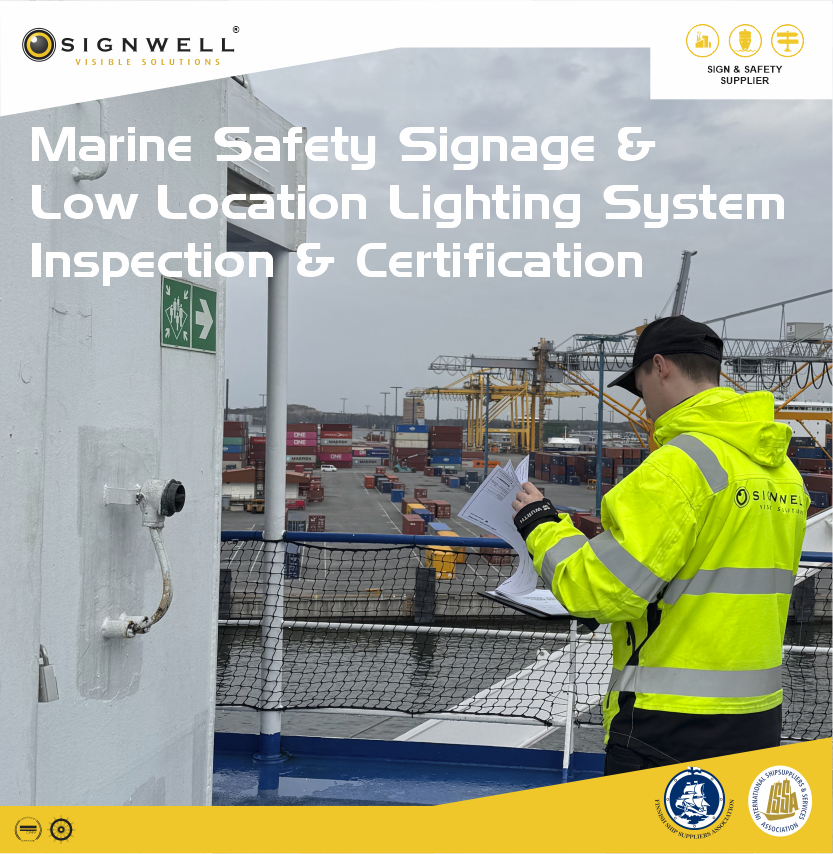
Investigators from bodies such as flag state authorities, the European Maritime Safety Agency (EMSA), and national marine accident investigation branches typically follow a structured evidence-gathering process. They photograph sign locations, measure luminance levels of photoluminescent materials, check whether symbols conform to IMO Resolution A.760(18) pictogram requirements, and verify that multilingual or symbolic guidance was adequate for the crew and passenger mix on board.
Where CCTV footage or survivor testimony describes confusion during evacuation, investigators cross-reference those accounts with the actual sign layout. If passengers moved in the wrong direction toward a muster station, investigators will ask whether directional escape route signs were present at every decision point along the route. The physical evidence of signage either corroborates or contradicts witness accounts, making it a critical layer of the investigation record.
What happens when IMO signs are missing or non-compliant in an accident?
When IMO safety signs are found to be missing, degraded, incorrectly positioned, or non-compliant with applicable standards, investigators formally classify them as contributing factors to the accident or to the severity of its consequences. This classification carries regulatory weight: it triggers mandatory corrective actions, may affect insurance liability assessments, and can result in port state control detentions.
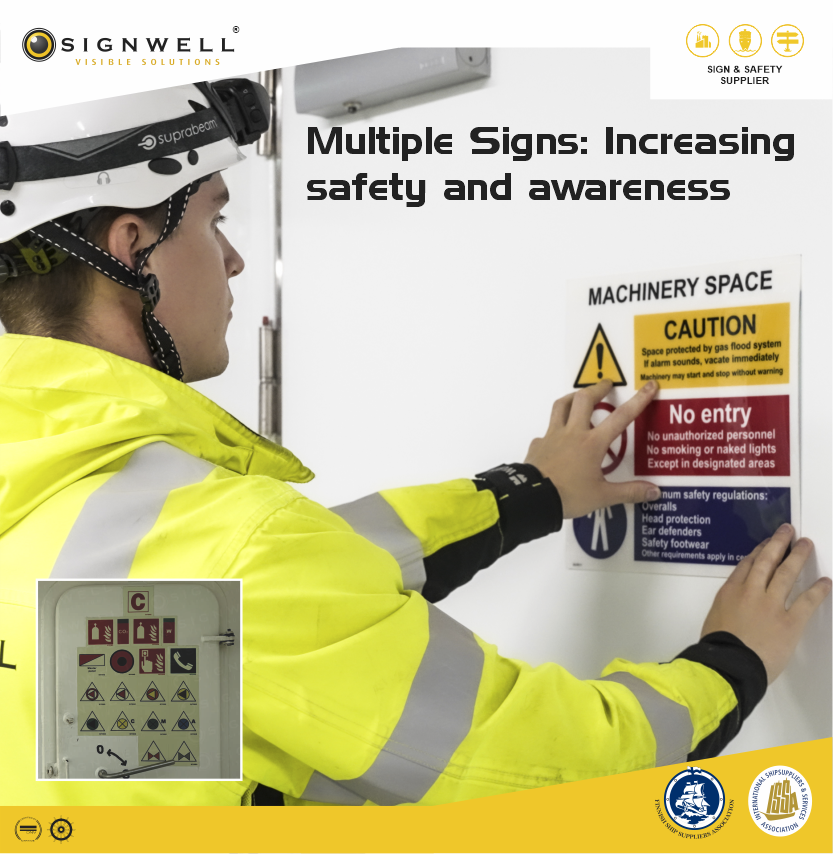
Non-compliance findings typically fall into several categories. Signs may use outdated pictograms that predate current IMO symbol requirements. Photoluminescent materials may have degraded below the minimum luminance threshold required for visibility in smoke-filled or darkened spaces. Signs may be positioned too high on bulkheads to remain visible when smoke accumulates at ceiling level. In some cases, signs are simply absent from locations where SOLAS regulations require them.
The consequences for vessel operators extend beyond the immediate investigation. Classification societies reviewing the report may require deficiencies to be rectified before the vessel’s next survey. Repeated non-compliance across a fleet can prompt flag state scrutiny of the operator’s entire safety management system under the ISM Code, elevating what began as a signage issue into a broader compliance concern.
Which IMO and SOLAS standards are cited most in accident reports?
The standards most frequently cited in maritime accident investigation reports relating to safety signage are SOLAS Chapter II-2 (fire protection, detection, and extinction), SOLAS Chapter III (life-saving appliances and arrangements), IMO Resolution A.752(18) on evaluation, testing, and application of low-location lighting, and IMO Resolution A.760(18) on symbols related to life-saving appliances and arrangements.
IMO Resolution A.752(18) receives particular attention in reports involving evacuation failures because it defines the performance requirements for low location lighting systems, including the photoluminescent and electrically powered systems that guide occupants along escape routes. When investigators find that a vessel’s low location lighting did not perform adequately, this resolution provides the benchmark against which actual performance is measured.
ISO 15370:2021, which covers low-location lighting on passenger ships, is increasingly referenced in more recent investigation reports as the standard has been updated to reflect advances in photoluminescent and LED technology. For vessels operating on international routes, compliance with these standards is not optional: SOLAS makes them binding through flag state implementation, and investigators treat deviation from them as a regulatory breach rather than a best-practice shortfall.
How do Low Location Lighting systems appear in evacuation incident findings?
Low Location Lighting systems appear in evacuation incident findings primarily in two contexts: cases where the systems performed as intended and aided successful evacuation, and cases where system failures, inadequate coverage, or poor maintenance contributed to disorientation and delayed escape. Investigators assess both the design of the system and its actual condition at the time of the incident.
In incidents involving fires or power failures, Low Location Lighting is often the last remaining visual guidance available to evacuees. Smoke rises and obscures overhead signage quickly, while floor-level or low-bulkhead photoluminescent markings remain visible for longer. Investigation reports that document successful evacuations frequently credit a functioning low location lighting system as a factor that kept passengers moving in the correct direction despite poor visibility.
Conversely, reports documenting evacuation failures often note that photoluminescent strips had not been recharged by adequate ambient light, that sections of the system had been covered during maintenance work and not reinstated, or that the system had gaps at corridor junctions where directional decision-making was most critical. These findings directly inform the corrective action recommendations that follow.
Our 3L-PL™ photoluminescent system and 3L-EP™ LED system are engineered specifically to meet and exceed the performance thresholds that investigators use as benchmarks in these findings, including compliance with IMO Resolution A.752(18) and ISO 15370:2021.
What corrective actions do accident reports typically recommend for safety signage?
Accident investigation reports typically recommend corrective actions in four areas: replacing non-compliant or outdated signs with current IMO-standard versions, extending or repairing low location lighting coverage to eliminate gaps, implementing a documented maintenance and inspection regime for all safety markings, and integrating signage verification into the vessel’s safety management system under the ISM Code.
Replacement recommendations are usually specific. Reports will identify particular decks, corridors, or spaces where signage was absent or non-compliant and require that deficiencies be addressed before the vessel returns to service or by a defined survey date. Where photoluminescent materials have degraded, reports may specify minimum luminance performance levels that replacement materials must achieve.
Maintenance and inspection recommendations reflect a recurring finding in accident investigations: signage that was compliant at the time of installation had deteriorated over time without detection. Reports frequently recommend that operators introduce periodic luminance testing of photoluminescent materials, include sign condition checks in routine safety rounds, and ensure that any maintenance work that temporarily removes or covers signs is followed by a formal reinstatement check.
At the systemic level, investigators increasingly recommend that signage compliance be treated as a standing agenda item in the vessel’s safety management system audits rather than a one-time installation task. This reflects a broader shift in maritime safety thinking: IMO safety signs and maritime safety markings are not passive fixtures but active safety systems that require the same ongoing management attention as fire detection or life-saving equipment.
Looking for IMO-compliant signage for your vessel? Explore Signwell’s IMO safety signs and find suitable safety signage for maritime environments.
This content was generated with the help of AI and it may contain mistakes