How do you create an IMO safety sign compliance plan for a fleet?
8.08.2026
Creating an IMO safety sign compliance plan for a fleet means establishing a structured, ship-by-ship framework that audits existing signage, maps each vessel against current SOLAS and IMO standards, schedules replacements, and maintains documentation that withstands port state control inspections. The plan must account for differences between vessel classes, flag state requirements, and the varying ages of ships in your fleet. The sections below answer the most common questions fleet managers face when building or updating that framework.
What regulations govern IMO safety signs across a fleet?
IMO safety signs across a fleet are governed primarily by SOLAS Chapter III (life-saving appliances) and Chapter II-2 (fire protection), supported by IMO Resolution A.952(23) on graphical symbols and ISO 17631 for photoluminescent materials. Flag state administrations may add requirements on top of these baseline standards, so the regulatory picture varies depending on where your vessels are registered.
In practice, the most operationally relevant standards for sign specification are IMO Resolution A.752(18) for low-location lighting and ISO 15370:2021 for the design and performance of safety signs on ships. For pipe and system identification on vessels, ISO 14726 provides the framework. If your fleet operates in European waters, EU Directive 92/58/EEC on workplace safety signs may also apply to crew working areas.
Understanding which standards apply to each vessel in your fleet is the essential first step before any audit or compliance plan can be built. A vessel flagged in one jurisdiction may face stricter or more specific requirements than one flagged elsewhere, even if both operate on the same trade route.
How do you audit existing safety signs across multiple vessels?
Auditing safety signs across multiple vessels requires a standardized checklist applied consistently to each ship, covering sign location, condition, photoluminescent performance, material compliance, and conformity to current IMO graphic symbols. Each vessel should be audited against its specific regulatory requirements based on flag state, vessel type, and build year.
A practical fleet audit follows this sequence:
- Define the scope for each vessel class, including applicable standards and any flag state additions.
- Create a location inventory mapping every required sign position: evacuation routes, muster stations, fire equipment, life-saving appliances, and pipe systems.
- Assess current signs against material condition, symbol accuracy, photoluminescent brightness, and mounting integrity.
- Record non-conformances with photographs, location codes, and the specific standard being breached.
- Prioritise findings by safety criticality, with evacuation route and life-saving appliance signs ranked highest.
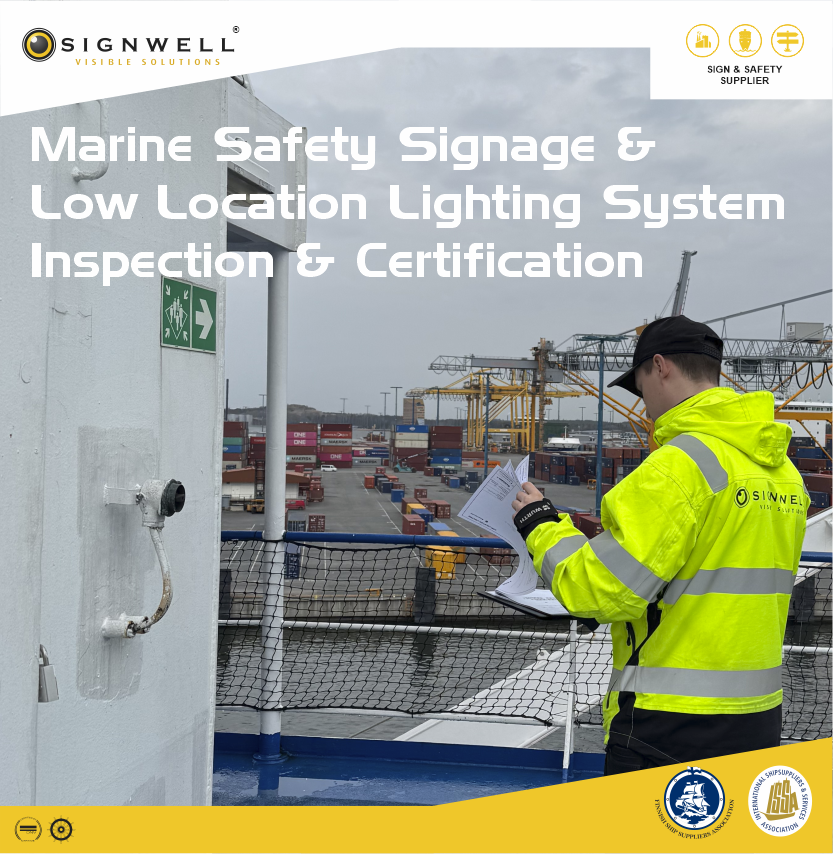
We provide DNV-certified 3L-SI inspections that follow exactly this kind of structured methodology, giving fleet operators a defensible, documented baseline from which to build their compliance plan.
What should a fleet-wide IMO sign compliance plan include?
A fleet-wide IMO sign compliance plan should include a regulatory baseline for each vessel class, a current-state audit summary, a prioritised replacement schedule, procurement and installation standards, a documentation management system, and a review cycle aligned with drydock and survey schedules.
The most effective plans treat compliance as an ongoing programme rather than a one-time project. Key components include:
- Vessel register: A record of every ship in the fleet with its flag state, class notation, build year, and applicable sign standards.
- Non-conformance tracker: A live list of identified deficiencies, their severity, responsible party, and target close-out date.
- Approved sign specifications: A standardised bill of materials defining acceptable sign types, materials, and suppliers for each vessel class to avoid inconsistency across the fleet.
- Installation and handover records: Certificates, photographs, and sign schedules that prove correct installation at each location.
- Review triggers: Defined events that prompt a compliance review, such as a regulatory update, a flag state change, a vessel modification, or a failed port state control inspection.
Keeping the plan as a living document rather than a static report is what separates fleets that pass inspections consistently from those that scramble before each survey.
How do you manage sign compliance across different vessel classes?
Managing sign compliance across different vessel classes means creating class-specific sign schedules rather than applying a single fleet-wide template. Tankers, bulk carriers, passenger vessels, and offshore support vessels each carry different SOLAS requirements, and a compliance plan must reflect those differences while still using standardised materials and documentation formats across the fleet.
The most efficient approach is to group vessels into class categories and develop a master sign schedule for each group. This schedule defines which signs are required, where they must be located, what material specification they must meet, and how often they should be inspected. When a new vessel joins the fleet or a vessel is modified, you apply the relevant class schedule rather than starting from scratch.
Passenger vessels deserve particular attention because SOLAS requirements for low-location lighting and evacuation guidance are significantly more demanding than for cargo ships. Ensuring that photoluminescent or electrically powered guidance systems meet the performance thresholds in ISO 15370:2021 and IMO Resolution A.752(18) is a compliance area where class-specific planning prevents costly retrofits later.
When should IMO safety signs be replaced or upgraded?
IMO safety signs should be replaced when they show physical deterioration, when photoluminescent performance falls below the threshold required by applicable standards, when a regulatory update changes the required graphic symbol, or when a vessel undergoes modification that changes evacuation routes or equipment locations. Proactive replacement on a scheduled cycle is far more cost-effective than reactive replacement after a failed inspection.
Photoluminescent signs degrade over time even when they appear visually intact. Industry experience shows that the afterglow performance of lower-grade materials can fall below SOLAS thresholds well before the sign shows visible damage. High-quality signs manufactured to exceed standard requirements, such as those meeting the performance levels set in ISO 15370:2021, offer significantly longer service lives and reduce the frequency of replacement cycles across a large fleet.
Regulatory upgrades are another common trigger. When IMO updates graphic symbols or when a new resolution comes into force, signs displaying superseded graphics may need replacement even if they are physically undamaged. Monitoring IMO circulars and MSC resolutions as part of your compliance plan ensures these changes do not catch your fleet off guard.
How do you keep compliance documentation ready for port state control?
Keeping compliance documentation ready for port state control means maintaining a vessel-specific sign register that includes installation records, material certificates, photoluminescent performance data, and the date of the most recent inspection, all accessible on board and retrievable within minutes of a PSC officer’s request.
Port state control officers increasingly focus on the traceability of safety systems, not just their physical condition. A well-prepared documentation package for IMO safety sign compliance typically includes:
- A complete sign location schedule with reference to the applicable standard for each sign type
- Material compliance certificates confirming signs meet the required photoluminescent or electrical performance standards
- Installation certificates or handover records signed by a qualified inspector
- Records of any non-conformances identified and the corrective actions taken
- The date and scope of the most recent compliance inspection
Storing this documentation in a structured digital format, linked to the vessel’s safety management system, makes retrieval straightforward and demonstrates to PSC officers that sign compliance is actively managed rather than assumed. Fleets that treat documentation as an afterthought consistently face more detentions and deficiency notices than those that build it into the compliance plan from the outset.
This content was generated with the help of AI and it may contain mistakes