How do you maintain pipe marking legibility in high-humidity environments?
10.10.2026
To maintain pipe marking legibility in high-humidity environments, choose moisture-resistant label materials such as polyester, vinyl, or anodized aluminum, and ensure surfaces are thoroughly cleaned and dried before application. Adhesion failure and ink degradation are the two main causes of illegibility in wet or humid spaces, so both material selection and installation technique matter equally. The questions below unpack each factor in detail, from material choices and standards compliance to inspection schedules and marine-grade solutions.
What causes pipe markings to fail in humid conditions?
Pipe markings fail in humid conditions primarily because moisture weakens adhesive bonds, causes label edges to lift, and accelerates ink or print degradation. Condensation that cycles repeatedly between wet and dry states is especially damaging, as it works the adhesive loose from the substrate over time. Corrosion on the pipe surface beneath the label can also break the bond from underneath.
Beyond adhesive failure, humidity creates an environment where certain inks and coatings absorb moisture and become cloudy or illegible. Labels made from paper or standard vinyl are particularly vulnerable because they absorb water rather than repelling it. Once the print layer is compromised, the marking no longer communicates its safety information reliably, creating a compliance gap and a genuine safety risk. Mechanical factors compound the problem: vibration, thermal expansion, and cleaning with high-pressure water jets all stress the label edges, and moisture makes those edges far more susceptible to peeling.
What materials are best for pipe labels in wet or humid areas?
The best materials for pipe labels in wet or humid areas are polyester film, UV-stabilized vinyl, and anodized or stainless-steel nameplates. These materials resist moisture absorption, maintain adhesive strength through repeated wet-dry cycles, and preserve print clarity over long service lives. For the most demanding environments, metal-backed labels or photoluminescent materials with sealed print layers offer the highest durability.
Polyester film labels are a practical choice for most industrial settings because they combine flexibility with strong moisture resistance and accept high-resolution printing. UV-stabilized vinyl is similarly effective and handles outdoor or partially exposed pipework well. Where chemical splash is also a concern alongside humidity, overlaminated labels add an extra protective barrier over the printed surface. In marine and offshore contexts, halogen-free materials that comply with fire and smoke toxicity requirements are essential, not just moisture resistance. Anodized aluminum tags are a reliable choice when labels must survive both immersion risk and abrasion from maintenance activity.
How do pipe marking standards address high-humidity environments?
Pipe marking standards such as ISO 14726 and PSK 0903 set requirements for color coding, symbol use, and label placement, but they also implicitly demand durability by requiring that markings remain legible throughout a system’s operational life. ISO 14726 governs pipe identification on ships and marine structures, where humidity resistance is a baseline expectation given the operating environment.
PSK 0903, the Finnish industrial pipe marking standard that we at Signwell helped initiate, specifies performance criteria that labels must meet under realistic industrial conditions, including elevated moisture levels. ISO 20560-1 extends similar principles to hazardous fluid identification. While these standards do not always prescribe a specific material, they require that the chosen solution maintains legibility and color accuracy over time, which in practice rules out paper-based or low-grade adhesive labels in humid spaces. Facilities that operate under SOLAS or IMO regulations face additional requirements, since safety-critical markings on vessels must remain readable in emergency conditions, including after exposure to water.
How should pipe markings be installed to maximize longevity in humid spaces?
To maximize longevity in humid spaces, pipe markings should be applied to a clean, dry, and grease-free surface, with the pipe at or near ambient temperature. Applying labels to cold pipes that are actively condensing is one of the most common causes of early adhesion failure and should always be avoided.
Surface preparation is the most important installation step. Wipe the pipe with an isopropyl alcohol solution and allow it to dry fully before applying the label. For curved or small-diameter pipes, use labels with a flexible substrate that conforms to the surface without creating air pockets at the edges, since trapped moisture under an air pocket accelerates peeling. Pressing the label firmly from the center outward removes air and maximizes contact area. In environments with frequent condensation, applying a bead of edge sealant around the label perimeter after installation provides an additional moisture barrier. For permanent installations in extreme conditions, mechanical fasteners or cable-tie-mounted label holders eliminate adhesive dependency altogether.
How often should pipe markings be inspected and replaced in humid environments?
In high-humidity environments, pipe markings should be inspected at least every six months, with replacement triggered whenever legibility, color accuracy, or adhesion is visibly compromised. Facilities subject to regulatory audits or SOLAS compliance checks may require more frequent documented inspections.
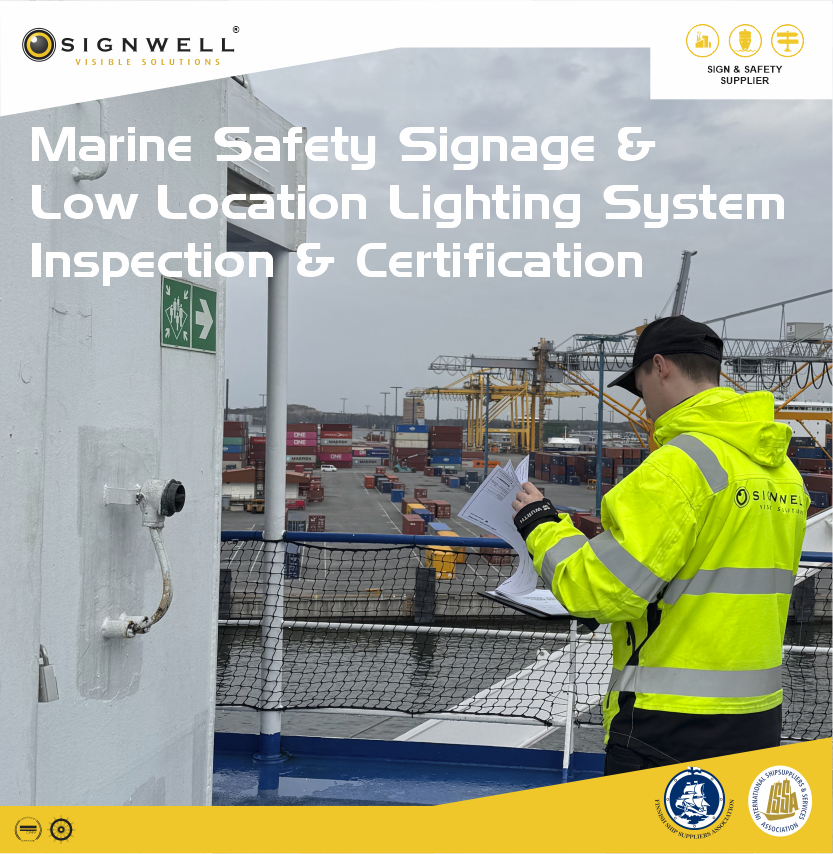
A practical inspection routine checks for edge lifting, discoloration, cracking, and any fading that makes text or color bands difficult to read at normal working distance. Markings near steam lines, wash-down zones, or outdoor exposed pipework typically degrade faster than those in controlled indoor spaces and warrant more frequent attention. Keeping a record of inspection dates and replacement actions supports compliance documentation and helps identify areas where a more durable label specification is needed. We offer 3L-SI inspection services carried out by DNV-certified inspectors, which can be a practical option for facilities that need independent verification of marking system condition.
What’s the difference between standard and marine-grade pipe marking solutions?
Standard pipe marking solutions are designed for controlled industrial environments with moderate temperature and humidity variation. Marine-grade pipe marking solutions are engineered to withstand continuous salt air exposure, high humidity, vibration, UV radiation, and the fire and smoke toxicity requirements imposed by SOLAS and IMO regulations. The gap between the two is significant in both material specification and regulatory compliance.
Material and construction differences
Marine-grade labels use substrates and adhesives selected specifically for saltwater resistance and thermal cycling. Our New Generation IMO signs are manufactured from PVC-free and halogen-free materials, exceeding standard requirements by a factor of four in terms of photoluminescent brightness and longevity. Standard industrial labels rarely carry these certifications because their operating environments do not demand them.
Regulatory and compliance differences
Marine-grade solutions must align with ISO 14726 for pipe identification and IMO Resolution A.752(18) for safety signs, among other standards. Standard industrial pipe marking typically follows ISO 20560-1 or national standards such as PSK 0903. A label that is fully compliant for an onshore processing plant may not meet the material, legibility, or fire-performance requirements for use on a vessel or offshore platform. Selecting the right specification from the outset avoids costly retrofitting and ensures that markings remain valid through flag-state inspections and port-state control checks.
For a clear and standardized approach to identifying piping on board vessels, explore Signwell’s ISO 14726 marine pipe marking solutions.
This content was generated with the help of AI and it may contain mistakes