What pipe marking standards apply to ships in 2025?
31.10.2025
Ship pipe marking in 2025 requires compliance with ISO 14726, the international standard specifically designed for ships and marine technology. This standard works alongside IMO resolutions and flag state requirements to ensure proper identification of piping systems throughout vessels. Proper marine pipe marking enables quick system identification during emergencies, supports multilingual crew operations, and satisfies classification society inspections that verify safety compliance.
What are the main pipe marking standards that apply to ships?
Ships must comply with ISO 14726 as the primary international standard for pipe identification, supplemented by IMO resolution A.752(18) for safety signs and flag state regulations. These standards create a comprehensive framework that ensures consistent identification across all vessel types and international waters.
ISO 14726 provides the technical specifications for marking content, colours, and placement on marine piping systems. It addresses the unique challenges of maritime environments where crews from different countries must quickly identify systems during routine operations and emergencies. The standard specifies requirements for fluid identification, flow direction indicators, and hazard warnings that remain legible despite exposure to salt water, temperature extremes, and mechanical wear.
IMO resolutions complement ISO 14726 by establishing safety requirements for passenger ships and cargo vessels operating internationally. Flag state authorities may impose additional requirements based on vessel type and operational area. Classification societies like DNV, Lloyd’s Register, and Bureau Veritas incorporate these standards into their survey requirements, making compliance essential for maintaining vessel certification.
Why is ISO 14726 the most important standard for ship pipe marking?
ISO 14726 serves as the internationally recognised standard because it addresses the specific challenges of marine environments that general industrial standards cannot accommodate. It provides comprehensive guidance on colour coding, text specifications, and durability requirements that withstand harsh maritime conditions whilst supporting multinational crew operations.
The standard establishes a systematic approach to pipe identification that works across different vessel types, from offshore platforms to passenger ships. It specifies colour codes for different media categories, including fire-fighting systems (red), ballast systems (green), and fuel lines (brown). These colours provide instant visual recognition that transcends language barriers, which proves critical when crew members from various countries must respond quickly during emergencies.
ISO 14726 also addresses practical installation challenges unique to ships. The standard recognises that marine pipe marking must remain legible despite constant vibration, temperature fluctuations between machinery spaces and weather decks, and exposure to cleaning chemicals and salt spray. We implement these requirements using materials specifically engineered for marine applications, ensuring markings maintain clarity throughout the vessel’s operational life.
How does pipe marking on ships differ from industrial facilities?
Marine pipe marking faces significantly more demanding conditions than onshore industrial facilities. Ships require markings that withstand extreme temperature variations, constant motion, salt water exposure, and confined space installation whilst serving multilingual crews operating in international waters where consistent identification becomes critical for safety.
Onshore facilities typically operate with stable crews who speak common languages and work in controlled environments. Ships operate with rotating international crews who may have limited familiarity with specific vessel layouts. This reality makes clear, standardised pipe marking essential rather than merely helpful. The markings must communicate instantly without requiring interpretation or local knowledge.
The physical environment also creates unique challenges. Marine pipe marking must endure temperature ranges from freezing weather decks to engine rooms exceeding 50°C. Constant vibration and occasional impacts during rough seas test adhesive bonds and material durability. Salt water exposure accelerates corrosion and degradation of inferior marking materials. Confined spaces in machinery compartments and cargo holds make installation more difficult whilst simultaneously increasing the importance of clear identification when maintenance becomes necessary.
What information must be included on ship pipe markings in 2025?
Ship pipe markings must display the fluid content name, flow direction arrows, and appropriate hazard warnings according to ISO 14726 requirements. Additional information includes system identification codes, pressure ratings, and temperature specifications for critical systems. Colour coding provides immediate visual identification whilst text ensures precise system recognition.
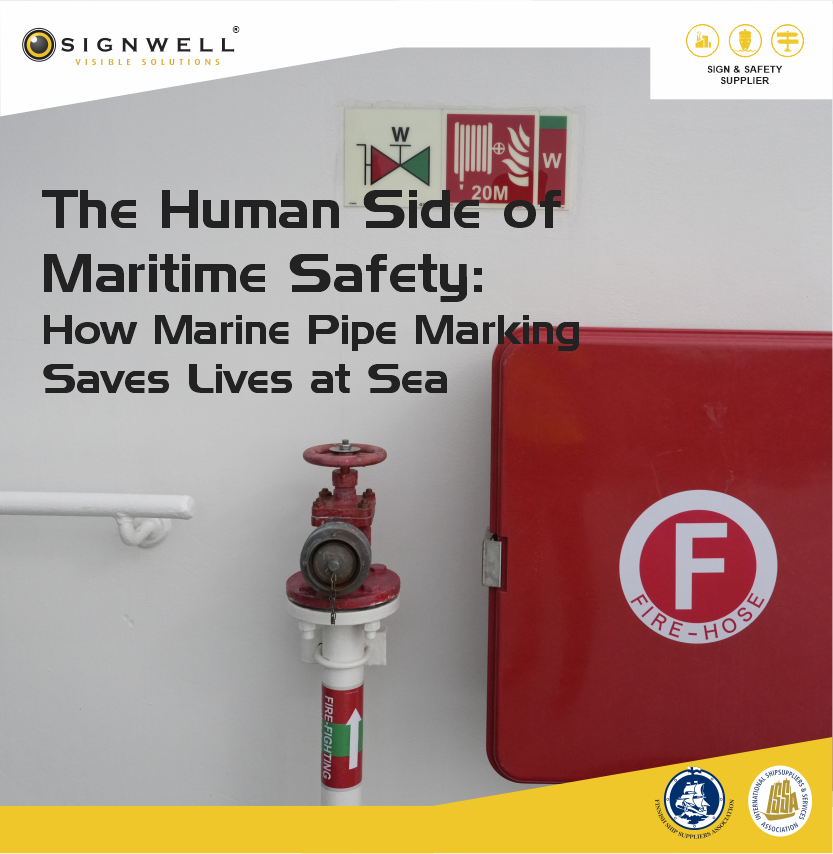
Fire-fighting systems require red backgrounds with white text, clearly marked with “FIRE MAIN” or specific extinguishing agent names. Ballast systems use green backgrounds identifying specific tanks and pump connections. Fuel systems display brown backgrounds with clear identification of fuel type, whether diesel, heavy fuel oil, or alternative fuels. Hydraulic systems use orange backgrounds to distinguish them from other pressurised lines.
Flow direction arrows must appear at regular intervals, particularly at junctions and equipment connections where personnel need quick orientation. Hazard warnings indicate flammable, toxic, or high-temperature contents using internationally recognised symbols. System identification codes help maintenance crews trace piping through complex routing in machinery spaces and service areas. We ensure all these elements meet size, spacing, and placement requirements that maintain legibility even in poorly lit compartments where emergency response may occur.
How do you ensure pipe marking compliance during ship inspections?
Maintaining compliant pipe marking requires proper installation quality, durable materials, and systematic documentation that satisfies flag state surveys and classification society inspections. Regular maintenance inspections should verify marking legibility, adhesion quality, and information accuracy throughout the vessel’s operational life.
Installation quality determines long-term compliance. Proper surface preparation ensures strong adhesion that withstands vibration and temperature cycling. Marking placement must follow ISO 14726 specifications for visibility and spacing, with particular attention to valve locations, equipment connections, and system branches where identification becomes most critical during operations.
Documentation proves essential during surveys. Maintaining records of marking specifications, installation dates, and material certifications demonstrates compliance with applicable standards. Classification society surveyors verify that marking systems match approved drawings and meet current regulatory requirements. We support vessel operators through these inspections by providing comprehensive documentation and conducting pre-survey assessments that identify any deficiencies requiring correction before official inspections.
Material durability directly affects compliance over time. Premium marine pipe marking materials maintain colour fastness and adhesion for years despite harsh conditions. Regular inspections should identify faded, damaged, or missing markings before they become survey findings. Establishing a systematic replacement programme ensures the marking system remains fully compliant throughout the vessel’s service life, supporting both safety operations and regulatory requirements.