How does marine pipe marking improve emergency response on ships?
30.10.2025
Marine pipe marking improves emergency response on ships by enabling crew members to instantly identify critical systems during high-stress situations. Clear, standardised markings reduce confusion, prevent dangerous mistakes, and allow personnel to locate fire suppression lines, bilge systems, and isolation valves within seconds. This visual guidance system becomes especially vital when visibility is compromised by smoke, power failures, or flooding, ensuring crew can respond effectively regardless of their familiarity with the specific vessel layout.
What is marine pipe marking and why is it critical during ship emergencies?
Marine pipe marking is a standardised visual identification system that labels piping networks aboard vessels to indicate content, flow direction, and system function. Unlike general industrial pipe marking, maritime systems must withstand extreme environmental conditions whilst remaining instantly recognisable during emergencies when crew members need to make split-second decisions that could save lives and prevent catastrophic failures.
During emergencies such as fires, flooding, or chemical spills, crew members must quickly locate and operate the correct systems. A fire in the engine room requires immediate identification of fire suppression lines, whilst flooding demands rapid access to bilge system controls. When every second matters, clear pipe marking eliminates guesswork and enables even crew members unfamiliar with a particular vessel to respond appropriately.
Maritime pipe marking differs fundamentally from shore-based industrial systems because vessels operate in harsh saltwater environments, experience constant vibration and temperature fluctuations, and house multinational crews who may not share a common language. The marking system must communicate universally through colour codes, symbols, and standardised formats that transcend language barriers.
These markings integrate seamlessly with overall vessel safety management systems and emergency response protocols. They work alongside emergency lighting, evacuation routes, and safety equipment signage to create a comprehensive safety infrastructure. When properly implemented according to ISO 14726 standards, pipe marking becomes part of the vessel’s permanent safety documentation, supporting training programmes and emergency drills.
How does standardised pipe marking reduce emergency response time on vessels?
Standardised pipe marking reduces emergency response time by eliminating the cognitive load associated with system identification during high-stress situations. When crew members can instantly recognise fire suppression lines through consistent colour coding, directional arrows, and content labels, they bypass the need for mental processing or reference checking. This immediate recognition can reduce response time from minutes to seconds in critical situations.
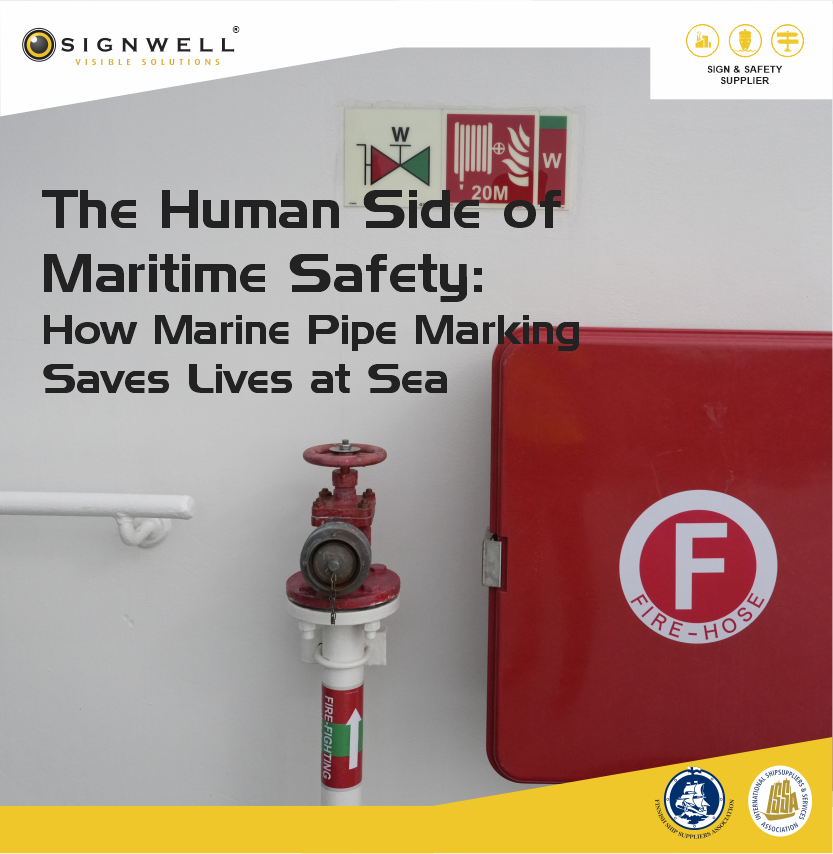
The system works through multiple visual cues that reinforce each other. Colour coding provides instant system recognition from a distance, directional arrows show flow paths for quick tracing, and content labels specify exactly what each pipe carries. A crew member responding to a fire can follow red-marked fire main lines directly to connection points without consulting diagrams or asking for guidance.
This standardisation becomes particularly valuable for crew members who may be responding to emergencies on vessels they’ve recently joined or in areas of the ship they don’t regularly work. International maritime operations often involve multinational crews with varying experience levels. Standardised marking ensures that a crew member trained on one vessel can effectively respond on another, reducing the learning curve and maintaining consistent safety standards across fleets.
During emergencies, stress significantly impairs decision-making abilities. Clear, standardised markings reduce the mental effort required to identify systems, allowing crew members to focus their cognitive resources on executing proper emergency procedures rather than figuring out which pipes serve which functions. This reduction in cognitive load can mean the difference between controlled emergency response and escalating disaster.
What are the key IMO and ISO standards for marine pipe marking systems?
The primary international standard governing marine pipe marking is ISO 14726, which establishes comprehensive requirements for identification of pipe contents aboard ships and marine structures. This standard specifies colour schemes, label placement, information content, and durability requirements that ensure consistency across international maritime operations. IMO resolutions, particularly those related to SOLAS (Safety of Life at Sea) requirements, mandate proper identification systems as part of overall vessel safety compliance.
ISO 14726 requires specific colour coding based on pipe content categories: red for fire-fighting systems, green for fresh water, yellow for dangerous substances, and additional colours for various fluid types. The standard specifies that markings must include flow direction indicators, content identification, and appropriate hazard warnings. Label placement must occur at strategic locations including valves, bulkhead penetrations, and regular intervals along pipe runs to ensure visibility from multiple positions.
Durability requirements under these standards are stringent. Markings must withstand saltwater exposure, temperature extremes, UV radiation, and mechanical wear whilst maintaining legibility throughout the vessel’s operational life. The standards specify testing protocols that verify marking materials can endure these conditions without fading, peeling, or becoming illegible. We ensure our marine pipe marking solutions comply with ISO 14726, providing documentation that supports vessel certification processes.
Compliance with these standards ensures consistency across international fleets, enabling multinational crews to respond effectively regardless of vessel origin. A crew member trained on Norwegian-flagged vessels can immediately understand pipe systems on Singapore-registered ships because both follow the same international standards. This harmonisation is essential for crew transfers, emergency mutual aid between vessels, and maintaining safety standards across global maritime operations.
How does pipe marking support different types of shipboard emergencies?
Proper pipe marking facilitates appropriate responses across various emergency scenarios by providing instant system identification when crew members need it most. During fire response, clearly marked fire main connections, foam concentrate lines, and sprinkler system piping enable rapid deployment of suppression systems. Crew can quickly identify which valves to open, where to connect hoses, and how to isolate fuel lines that might feed the fire.
Flooding emergencies require immediate identification of bilge systems, watertight door hydraulic lines, and ballast controls. Clear marking prevents catastrophic mistakes such as opening valves that would worsen flooding or closing systems needed for damage control. Emergency bilge systems must be instantly recognisable so crew can activate pumping operations without delay, whilst ballast system markings enable rapid stability adjustments to counter flooding effects.
Chemical spill scenarios demand precise identification to prevent dangerous reactions. Marking systems help crew identify what substances are in nearby pipes, enabling proper containment procedures and preventing accidental mixing of incompatible materials. This becomes critical when responding to cargo system leaks or processing equipment failures where wrong actions could create toxic gases or explosive conditions.
System failures often require rapid isolation of affected sections whilst maintaining critical services. Pipe marking allows crew to trace systems quickly, identify isolation valves, and establish bypass configurations when necessary. During power failures, photoluminescent marking materials remain visible, ensuring crew can still identify critical systems when normal lighting is unavailable. This multi-scenario functionality makes comprehensive pipe marking an essential component of vessel emergency preparedness.
What makes marine pipe marking durable enough for emergency situations?
Marine pipe marking must withstand extraordinarily harsh environmental conditions to remain effective during emergencies. Materials must resist continuous saltwater exposure, temperature extremes ranging from freezing conditions to engine room heat, intense UV radiation on deck areas, and chemical exposure from various shipboard operations. The marking systems we provide are engineered specifically for these challenges, using marine-grade materials that maintain legibility throughout extended service life.
Testing standards verify that marking materials can endure these conditions without degradation. Accelerated weathering tests simulate years of UV exposure, salt spray chambers verify corrosion resistance, and temperature cycling confirms performance across operational ranges. Premium marine marking systems are designed to withstand temperatures from -40°C to +150°C whilst maintaining adhesion and legibility, ensuring they remain functional in all shipboard environments from refrigerated cargo holds to machinery spaces.
Photoluminescent marking options provide critical visibility during power failures or smoke-filled conditions when traditional markings become invisible. These materials absorb ambient light and emit a visible glow in darkness, enabling crew to identify pipe systems even when emergency lighting fails. This capability can be lifesaving during scenarios where electrical systems are compromised, ensuring emergency response capabilities remain intact regardless of lighting conditions.
Longevity expectations for properly specified marine marking systems typically exceed 15 years with minimal maintenance. This extended service life reduces lifecycle costs whilst ensuring consistent safety performance. Physical wear resistance prevents damage from routine maintenance activities, cargo operations, and crew movement through tight spaces. The combination of environmental durability and physical resilience ensures that marking systems remain effective throughout their intended service life, providing reliable guidance whenever emergencies occur.
Effective marine pipe marking represents a fundamental investment in vessel safety that pays dividends during every emergency situation. The combination of standardised visual communication, durable materials, and compliance with international regulations creates a safety infrastructure that supports crew response capabilities across all operational scenarios. Whether responding to fires, flooding, or system failures, properly implemented pipe marking systems provide the instant recognition and clear guidance that enable effective emergency response when every second matters most.