How does pipe marking prevent costly errors in marine operations?
5.10.2025
Marine pipe marking prevents costly errors by providing instant visual identification of pipe contents, flow direction, and hazard levels in complex vessel systems. Clear, standardised markings enable crew members to quickly locate critical systems during emergencies, avoid connecting incompatible substances during maintenance, and respond correctly without language barriers. Proper pipe marking eliminates confusion that leads to equipment damage, environmental incidents, and operational delays whilst ensuring compliance with international maritime regulations.
What is pipe marking and why is it critical for marine operations?
Pipe marking is a colour-coded identification system that communicates pipe contents, flow direction, and hazard levels throughout vessel piping networks. These markings use standardised colours, text labels, and directional arrows to create an instantly recognisable visual language that works across language barriers and enables rapid system identification in both routine operations and emergency situations.
The critical importance of marine pipe marking becomes evident when considering the complexity of modern vessel systems. Ships and offshore platforms contain hundreds of pipes carrying everything from potable water and fuel to hazardous chemicals and compressed gases. Without clear identification, crew members face significant risks when operating valves, performing maintenance, or responding to emergencies.
Multi-lingual crews particularly benefit from standardised pipe marking systems. When crew members from different countries work together, visual identification transcends language barriers. A properly marked fuel line is immediately recognisable regardless of whether the crew member speaks English, Mandarin, or Tagalog. This universal communication reduces response time during critical situations where seconds matter.
Marine environments present unique challenges that make robust pipe marking essential. Corrosion from saltwater exposure, temperature extremes ranging from freezing to engine room heat, and confined spaces with limited visibility all demand marking systems that remain legible under harsh conditions. Durable, UV-resistant materials ensure markings stay visible throughout the vessel’s operational life, maintaining safety even as other components age.
How does improper pipe marking lead to costly errors on ships?
Inadequate pipe marking creates confusion that leads to serious operational errors with cascading financial and safety consequences. When crew members cannot quickly identify pipe systems, they may open incorrect valves during emergencies, connect wrong systems during maintenance, or inadvertently mix incompatible substances. These mistakes trigger equipment damage, cargo contamination, environmental incidents, and crew injuries that result in substantial costs and operational disruptions.
Maintenance operations become particularly hazardous without proper pipe identification. Engineers performing routine work may accidentally connect a freshwater system to a wastewater line, or open a valve expecting compressed air but releasing hydraulic fluid instead. Such errors damage equipment requiring expensive repairs and replacement parts whilst extending vessel downtime that costs thousands daily in lost operational capacity.
Emergency response scenarios expose the most critical failures of inadequate pipe marking. During fires, crew members must instantly locate fire suppression systems. When fighting flooding, they need immediate access to bilge and ballast controls. Delays caused by searching for unmarked or poorly marked systems allow emergencies to escalate, potentially threatening vessel integrity and crew safety. The financial impact includes emergency repairs, salvage operations, and potential total loss in worst-case scenarios.
Regulatory penalties compound operational costs when inspections reveal non-compliant pipe marking. Port state control inspections can detain vessels failing to meet international standards, resulting in delayed schedules, contract penalties, and reputation damage. Insurance complications may arise when incidents occur on vessels with inadequate safety marking, potentially affecting claims and increasing premiums. Classification societies may require extensive remediation work before renewing certifications, adding further expense and operational disruption.
What are the international standards for marine pipe marking?
ISO 14726 serves as the primary international standard for ship pipe marking, establishing comprehensive requirements for colour coding, content identification, flow direction arrows, and hazard indication. This standard ensures consistency across international fleets, enabling crew members to understand pipe systems regardless of their previous vessel experience or native language. Proper implementation supports both safety compliance and operational efficiency in global maritime operations.
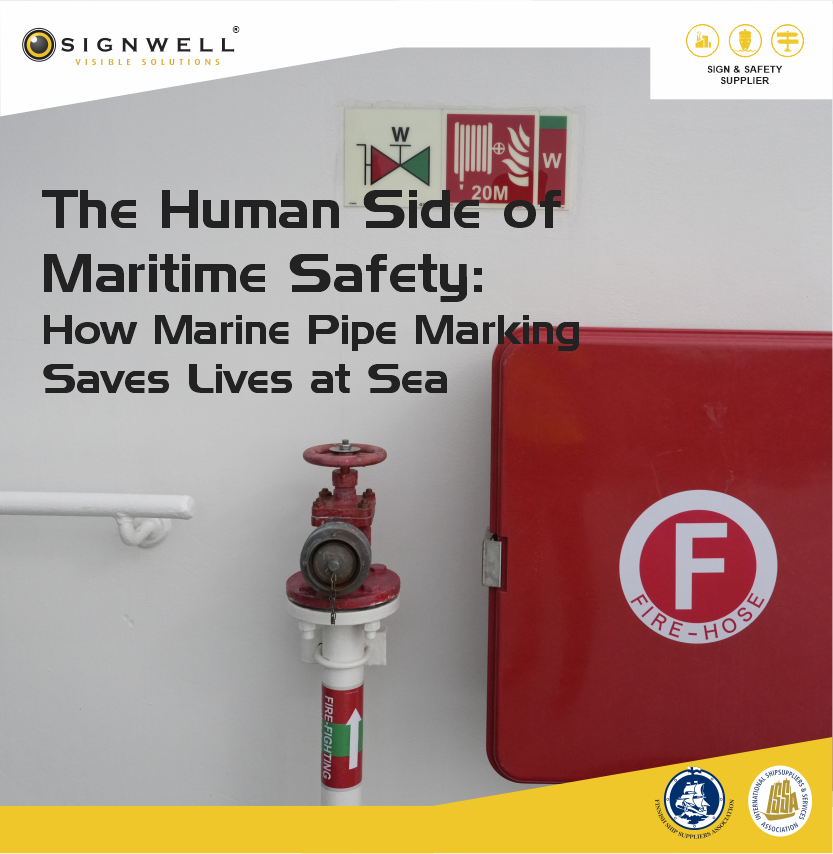
The standard specifies a colour system that communicates pipe contents at a glance. Water systems use green markings, oils and flammable liquids appear in brown or yellow, gases are identified with yellow markings, and chemical substances receive violet identification. Fire-fighting systems display red markings for immediate recognition during emergencies. These colours remain consistent across vessels, creating a universal language that transcends individual ship designs.
Beyond basic colour coding, ISO 14726 requires clear content identification labels that specify exactly what flows through each pipe. Flow direction arrows indicate the normal direction of media movement, crucial information for understanding system operation and troubleshooting problems. Hazard indication markings warn of specific dangers such as high temperature, high pressure, toxic contents, or corrosive materials, enabling crew members to take appropriate precautions.
Complementary standards work alongside ISO 14726 to create comprehensive safety frameworks. SOLAS (Safety of Life at Sea) requirements mandate proper identification of safety systems including fire suppression and emergency equipment. IMO regulations establish broader safety management requirements that include proper system identification. Classification societies such as DNV, Lloyd’s Register, and Bureau Veritas incorporate pipe marking requirements into their vessel certification processes, ensuring compliance throughout the vessel lifecycle.
We provide ISO 14726-compliant pipe marking solutions that meet these international requirements whilst addressing the specific challenges of marine environments. Our systems ensure rapid emergency response, regulatory compliance, and crew safety through clear, durable identification that withstands harsh maritime conditions.
How should pipe marking be implemented on vessels and offshore platforms?
Implementing compliant pipe marking begins with comprehensive system assessment including pipe mapping, content identification, and hazard classification. This planning phase creates a complete inventory of all piping systems, determines appropriate marking colours and labels according to standards, and identifies optimal placement locations for maximum visibility. Proper assessment ensures the marking system serves both routine operations and emergency response needs effectively.
Material selection critically impacts marking longevity in marine environments. Marine pipe marking materials must resist UV degradation from constant sunlight exposure on deck areas, withstand saltwater corrosion that attacks inferior materials, and maintain legibility through temperature extremes from refrigerated spaces to engine rooms. Durable materials prevent the costly cycle of repeated replacement whilst ensuring safety information remains visible throughout the vessel’s operational life.
Placement strategies maximise marking effectiveness under various conditions. Markings should appear at regular intervals along pipe runs, at every valve location, where pipes pass through bulkheads, and at connection points. Consideration for both normal and emergency lighting conditions ensures visibility during power failures when emergency response becomes critical. Strategic placement in confined spaces accounts for limited viewing angles and restricted access that characterise many vessel areas.
Integration with ship documentation creates a complete identification system. Marking schemes should correspond to piping and instrumentation diagrams, enabling crew to cross-reference physical systems with technical drawings. Training programmes familiarise crew with the identification system, explaining colour codes, hazard symbols, and proper interpretation of directional arrows. Regular inspection and maintenance protocols ensure marking integrity over time, addressing wear, damage, or fading before legibility becomes compromised.
Professional implementation through experienced providers ensures compliance whilst optimising installation efficiency. We offer complete turnkey solutions covering design, manufacturing, installation, and ongoing maintenance support. Our approach ensures marking systems meet international standards whilst addressing vessel-specific operational requirements, creating safe working environments that prevent costly errors and support efficient marine operations.